Jahan Maka
1900 - 1987
Jahan Maka Biography
1900 - 1987
Jahan Maka was born Jonas Tomasiunas-Tomosenskas in 1900 in the small village of Svedasai, Lithuania. His father died when he was young, leaving him as the oldest son to tend the family farm amid turmoil over the occupation of the Baltic region. The farm was lost after World War I due to border shifts or land allocation. In 1927, Maka immigrated to Canada seeking work, intending to return to Lithuania to buy a farm. He anglicized his name to John Thomason and worked as an itinerant laborer in the western provinces, including as a farm hand and coal miner in Estevan, Saskatchewan.
Maka eventually settled in Flin Flon, Manitoba, where he worked as a hard rock miner until he retired in 1965. He lived in a rooming house he owned at the end of Hapnot Street near the lake and maintained connections with other Lithuanian immigrants, reading newspapers in his native language and receiving visits from them during his later years. In 1968, at age 68, he began painting with encouragement from his godson Tony Allison, an art student at the University of Manitoba, who supplied him with painting materials. Maka signed his works with the name Maka, a special clan name given to him in his youth.
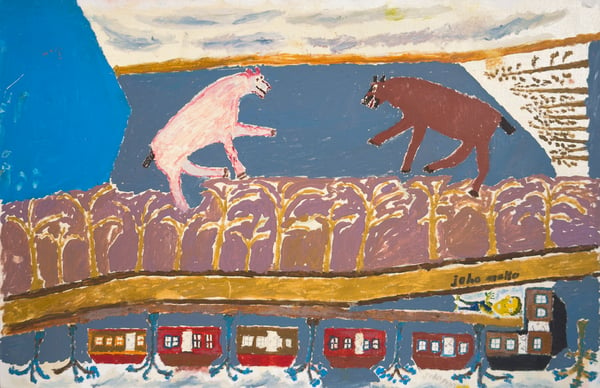
Maka worked with various materials including pastels, chalks, crayons, commercial enamels, airplane paint thinned with lighter fluid, appliance touch-up paint, wax crayons, and carpenter's chalk. He rebuilt worn paintbrushes with hairs from his own moustache and painted on walls or doors of his apartment when he ran out of canvas. He carved motifs from wood or linoleum and stamped them onto canvas or board. His paintings featured bright colors, flattened figures, and architectural structures, often viewed from an aerial perspective. His subjects included scenes from Lithuanian history, life in Canada, mining operations, and current events.
In 1977, Maka won first prize in a juried art exhibition sponsored by the Northern Manitoba Recreational Association, resulting in two solo exhibitions in Winnipeg in 1978. In spring 1983, he took a road trip with Allison to the southern United States and Mexico, where he purchased chalk, crayon, paint, and black paper used for his last series of drawings. Jahan Maka continued painting until his death in 1987 and is recognized as one of Canada's best-known self-taught artists.