Frederick Simpson Coburn
1871 - 1960 RCA
Frederick Simpson Coburn Biography
1871 - 1960 RCA
Frederick Simpson Coburn was born on March 18, 1871, in Upper Melbourne, a small village in Quebec's Eastern Townships. His artistic talent was recognized early by Dr. William Henry Drummond, who arranged for him to receive advice from the firm of Notman and Fraser about his art education. Coburn briefly studied at the Council of Arts and Manufactures School in Montreal before embarking on extensive training abroad. In 1890, at age nineteen, he traveled to the Royal Academy in Berlin, where he was drilled in draughtsmanship by Erhentraut and Skarbina. He subsequently studied with Jean-Léon Gérôme in Paris, where he was exposed to Impressionism, and then at the Slade School of Fine Art in London under Henry Tonks, who taught him to interpret rather than merely reproduce his subjects. His fascination with the Hague School took him to Holland, where he studied the work of the Maris brothers and J.H. de Weissenbruch. In 1897, while studying under Albrecht de Vriendt at the Institut Supérieur des Beaux-Arts in Antwerp, he came first in his class of thirty students. The following year, he won the Belgian Government's "Goot" subsidy, which provided three years of tuition-free study. During his European years, Coburn became fluent in French, German, Dutch, and Flemish.
In 1896, Coburn began collaborating with William Henry Drummond to illustrate Drummond's first volume of poetry about rural Quebec society, "The Habitant" (1897). To prepare for this work, he spent weeks living with and sketching habitant families, capturing intimate details of their lives. He went on to illustrate all of Drummond's works, executing these illustrations in black and white oils. This success led to a commission from another Quebec poet, Louis Fréchette, for whom he illustrated "Christmas in French Canada" (1899) and its French edition "La Noël au Canada" (1900). A productive collaboration with G.P. Putnam Company of New York followed, during which Coburn illustrated special classical editions by authors including Charles Dickens, Edgar Allan Poe, Alfred Lord Tennyson, Washington Irving, Oliver Goldsmith, and Robert Browning. He also illustrated magazine articles and covers for publications including the London Sporting and Dramatic News and the London News. These illustration assignments were crucial to his financial survival during his years of European study.
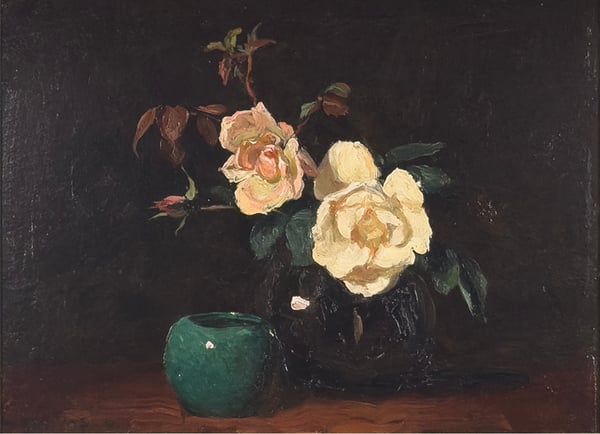
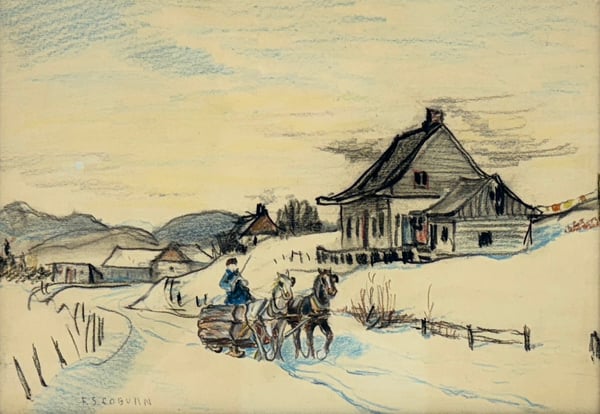
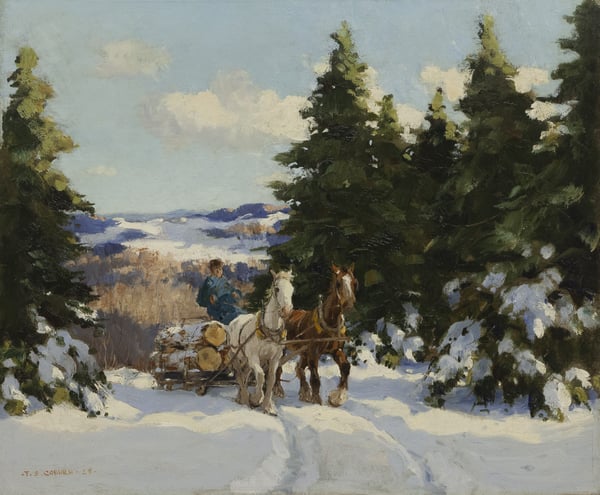
While living in Antwerp, Coburn met and married Malvina Scheepers, a talented Belgian artist. Together they established a studio-home in Upper Melbourne and maintained a pied-à-terre in Montreal, spending approximately twenty years based in Antwerp while making frequent visits to Canada. In the early 1900s, Coburn painted still lifes of flowers, portraits, and spring and summer landscapes of the Eastern Townships that reflected strong Dutch influence and were dark in tone. Around 1914, sketching trips with fellow artist Maurice Cullen brought about a dramatic transformation in his work. Inspired by Cullen's fascination with Canadian winter, Coburn abandoned his sombre Old-World palette to experiment with vivid colors and the study of light effects. He began specializing in oil paintings of horse and oxen-drawn sleds in Laurentian and Eastern Townships settings, works that captured the dazzling light, sharp colors, and mysterious snow shadows of the Canadian winter atmosphere. His unique treatment of luminous winter cloud effects became known as the "Coburn sky," and his winter scenes appeared regularly on Christmas cards and calendars from the late 1920s onward.
Coburn's work was exhibited in Canada and abroad. In 1928, he exhibited two canvases at the Imperial Gallery of Art Exhibition in London, England. In 1929, he won the Art Association of Montreal's Jessie Dow prize for his painting "March Morning." In 1932, the Arts Club of Montreal held a special exhibition of his Drummond illustrations. In 1938, he exhibited two paintings in the Tate Gallery's "A Century of Canadian Art" exhibition in London. He was elected a member of the Royal Canadian Academy of Arts in 1928 and became a senior member in 1941. In 1936, he received an honorary Doctor of Civil Law from Bishop's University in Lennoxville, Quebec. He was also a member and president (1942) of the Pen and Pencil Club of Montreal.
In 1933, when Coburn was sixty-two, his wife Malvina died while they were on vacation in Paris. Devastated by grief and feeling stereotyped by his reputation for winter scenes, he lost motivation until fellow artist Edmond Dyonnet encouraged him to meet Carlotta, a professional dancer and model. His subsequent twenty-seven-year relationship with her inspired a new phase of his work. He painted life-size canvases of Carlotta in elaborate dance costumes, including "Tango," "Bolero," "Rumba de Cuba," and "Cake Walk," which were exhibited at the Art Association of Montreal's Spring Show in 1936. He also became a photographer of note, creating striking photographs of Carlotta dancing against cumulus clouds. Coburn learned to dance himself and, together with Carlotta and her dance partner Alvarez, established a dance studio in Montreal. His work is represented in major collections including the National Gallery of Canada, the Tate Gallery in London, the National Gallery in Brisbane, Australia, and galleries in Japan, Belgium, Europe, and the United States. Frederick Simpson Coburn died peacefully in his Melbourne studio on May 26, 1960, at age eighty-nine.