Frederick S. Haines
1879 - 1960
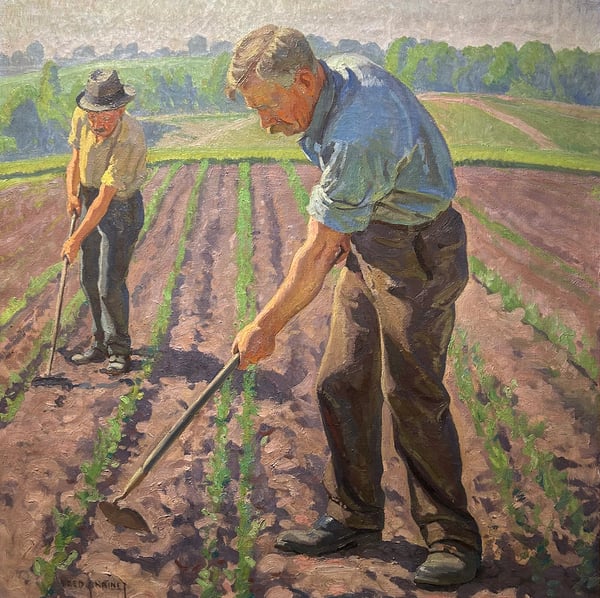
Frederick S. Haines Biography
1879 - 1960
Frederick Stanley Haines was born on March 29, 1879, in Meaford, Ontario. At age seventeen, he moved to Toronto to pursue his ambition of becoming an artist. He financed his studies at the Central Ontario School of Art by painting portraits for a travelling art dealer, studying under George Arthur Reid and William Cruikshank. He first exhibited with the Ontario Society of Artists in 1901 and was elected a member in 1906.
In 1913, Haines traveled to Europe to continue his studies at the Académie Royale des Beaux-Arts in Antwerp, Belgium, under Juliaan de Vriendt, where he was awarded a gold medal for figure painting. He returned to Toronto in 1914 and, influenced by John Wesley Cotton, began creating engravings and aquatints. In 1916, he became a founding member of the Society of Canadian Painter-Etchers and Engravers. In 1919, he became an associate member of the Royal Canadian Academy and expanded his practice to include printmaking. His etchings gained broad attention at a 1924 exhibition at the Art Gallery of Toronto, with Toronto's Star Weekly noting their "remarkable tone quality."
Haines was elected President of the Ontario Society of Artists in 1924. In 1920, he was appointed Secretary of the Graphic Art Department for the Canadian National Exhibition, and by 1924 became Commissioner of Fine Arts for the CNE. In this capacity during the 1930s, he was instrumental in bringing works by Picasso and Dali to the CNE art gallery. In 1925, he became a founding member of the Canadian Society of Painters in Water Colour, achieving full membership in 1933.
In 1928, Haines was appointed Curator at the Art Gallery of Toronto, a position he held until 1932 when he became Principal of the Ontario College of Art. As principal, he maintained a studio at the school where students could observe him working on his own paintings. He was elected President of the Royal Canadian Academy of Arts in 1939, serving until 1942. During World War II, his works "Beech Woods" and "Rural Bridge" were among the first Canadian landscapes reproduced as silkscreen prints by Sampson-Matthews for servicemen's hostels and lounges. He also collaborated with Ted Watson to design a Victory Torch that was flown to England in 1941 and presented to Prime Minister Winston Churchill.
Haines retired from teaching in 1951 at age 72 and returned to painting full time at his studio in Thornhill, Ontario. He was known for his pastoral Ontario landscapes, watercolours, oil paintings, gouaches, engravings, and prints. Though he worked in a figurative style himself, he maintained an open attitude toward abstract and non-objective painting styles among his peers and students. Haines died on November 21, 1960, in Thornhill. Following his death, the Art Gallery of Toronto held a retrospective exhibition of his work in 1961, which traveled to galleries in Hamilton, Windsor, and Sarnia. His work is represented in the National Gallery of Canada, Hart House at the University of Toronto, and other collections.