Luke Anowtalik
1932 - 2006
Luke Anowtalik Biography
1932 - 2006
Luke Anowtalik (1932-2006) was an Inuk artist from Arviat, Nunavut, recognized as one of the most important contemporary Inuit sculptors and known for his distinctive work in caribou antler, stone, and colored pencil drawings. Born at an Ahiarmiut (Caribou Inuit) camp near Ennadai Lake, Nunavut, Anowtalik was raised according to traditional Inuit beliefs and customs in a culture that relied almost entirely on caribou for material and spiritual existence. His early life was marked by tragedy when he and his younger sister Rita (Kunee) lost their parents to starvation during the late 1940s when the caribou migration patterns shifted. The siblings were relocated to Churchill, Manitoba by trapper Charlie Schweder, an experience documented in Farley Mowat's book "No Man's River."
Two years after this relocation, Anowtalik made a remarkable solo journey by dogsled back to Ennadai Lake, where he was rescued by the family of Andy Aulatjut. He subsequently married Aulatjut's daughter, Mary Ayaq Anowtalik, who also became a celebrated sculptor. The couple was featured on the cover of Life Magazine's February 27, 1956 issue with one of their children, bringing international attention to their story. Like many Inuit families of the period, the Anowtaliks were subjected to multiple forced relocations by the Canadian government, moving to Nueltin Lake in May 1950, then to Hennik Lake in 1957, and finally settling in Arviat in 1959.
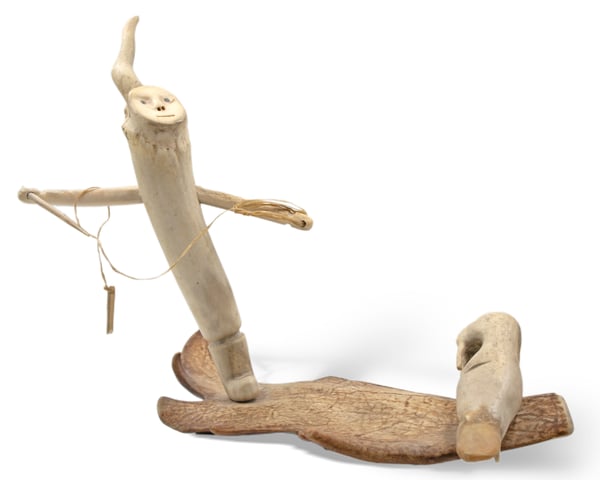
Anowtalik began his artistic career at a young age, recalling that he sold his first caribou antler carvings to government employees at Ennadai Lake. He formally began carving in 1962 when the arts movement was established in Arviat, frequently collaborating on sculptures with his wife Mary. His artistic practice encompassed three primary media, each reflecting different aspects of his cultural heritage and personal vision. His caribou antler sculptures, which he began creating as early as 1970, became perhaps his most distinctive contribution to Inuit art. These works demonstrated his masterful understanding of the material, as he typically removed most of the outermost cortical layer to reveal the underlying white bone while strategically retaining dark cortex areas to highlight features and define edges.
Anowtalik's antler carvings were characterized by their minimalist form and surrealist content, often featuring small figures with faces engraved on slightly angled planes using tiny holes for eyes and mouth and small protruding noses. The figures were frequently suspended on rounded pieces of bone, creating an evocative sense of levitation. His compositions typically depicted whimsical groupings of humans, birds, caribou, and other animals, embodying what art historian George Swinton described as the Arviat tradition of playful "folk art." One of his most celebrated works, "Acrobats" from the late 1990s, displays several figures dangling from poles in what appears to be a playful competition, exemplifying his ability to convey joy and movement through his chosen medium.
In contrast to the festive nature of his antler work, Anowtalik's stone sculptures frequently explored themes of family, community, and the relationship between humans and non-human beings. Working with the notably hard grey basalt stone quarried near Arviat, he created deeply carved and significantly worked pieces that demonstrated remarkable technical skill. During the 1970s, he produced some of his most impressive stone works alongside his wife, consisting of abstracted compositions featuring multiple heads and expressions carved in relief. Some pieces incorporated incised imagery, such as "Mother and Child" from the late 1960s, which features a caribou hunting scene carved on the right profile, connecting the intimate family subject with traditional subsistence practices.
Toward the end of his life, Anowtalik expanded his artistic practice to include bright, colorful drawings created with colored pencils. These works ranged from abstract compositions to realistic portrayals of caribou and scenes from daily life, demonstrating his continued engagement with both traditional subjects and experimental approaches to representation. This late period work showed his versatility as an artist and his ongoing commitment to documenting and interpreting Inuit life and spirituality.
Anowtalik's artistic legacy reflects the complex relationship between traditional Inuit culture and the forces of modernization and displacement that shaped twentieth-century Arctic life. His work embodies what art historians have recognized as the connection between the Inuktitut concept of "pinguaq" (meaning toy or playful imitation) and "sananguaq" (which came to mean carving and art in general), demonstrating how traditional cultural concepts evolved within contemporary artistic practice. His sculptures are held in major Canadian collections including the Canadian Museum of History in Gatineau, Quebec, the Winnipeg Art Gallery, and the National Gallery of Canada in Ottawa, ensuring that his distinctive vision of Inuit life and spirituality continues to reach audiences both within and beyond the Arctic.