Jacques de Tonnancour
1917 - 2005 OC OQ RCA
Jacques de Tonnancour Biography
1917 - 2005 OC OQ RCA
Jacques Godefroy de Tonnancour was born on January 3, 1917, in Montreal, Quebec. As a child, he was equally interested in insects and art, creating youthful drawings of butterflies that drew him to painting. At age 18, he found it difficult to choose between entomology and art as a career. In 1937, he enrolled at the École des beaux-arts de Montréal, thinking he would reconcile his scientific and artistic passions by becoming an illustrator of nature. However, while the school's library exposed him to 20th-century modern art, he found the teaching too conservative and academic. In 1940, exasperated by his "sterile development," he left after three years and denounced the school's conservative approach in an article in the Quartier Latin, the student newspaper of the University of Montreal.
With his father's assistance, de Tonnancour rented a studio with several friends and painted independently, producing work that showed influences ranging from the Group of Seven to the School of Paris. In 1940, he met Paul-Émile Borduas and Alfred Pellan, but felt more attracted to the personality and work of Goodridge Roberts, whose gestural, energetic paintings of the Laurentians echoed his own response to the land. De Tonnancour admired Borduas as a painter but was not in agreement with the political direction of the Automatistes. He joined the Contemporary Arts Society of Montreal in 1942 and held his first solo exhibition at the Dominion Gallery in Montreal the same year.
In 1945, de Tonnancour was awarded a grant by the government of Brazil and settled in Rio de Janeiro for sixteen months, where he created major canvases inspired by the luxurious and exotic environment. Upon his return to Canada in 1946, he became disenchanted with the more familiar landscape of his homeland and turned to still life and figure studies, strongly influenced by Picasso and Matisse. By this time, he felt too strongly influenced by these artists and stopped painting almost completely from 1950 to 1955, producing only a dozen canvases during this period.
In 1948, de Tonnancour helped compose the manifesto that Alfred Pellan used to establish the Prisme d'yeux group, which opposed those who would sign the Refus Global later that year. The manifesto stated: "We seek a painting freed from all contingencies of time and place, of restrictive ideology, conceived without any literary, political, philosophical or other meddling which could dilute its expression or compromise its purity." The group felt that painting should not be a political act. De Tonnancour was hired to teach at the École des beaux-arts de Montréal in 1948.
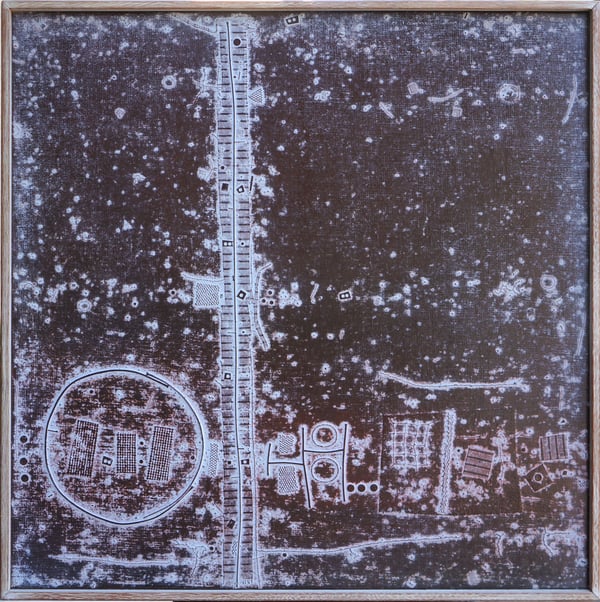
In the mid-1950s, travels in the Laurentians, northern Ontario, and Vancouver revived his passion for the Canadian countryside and its vast spaces. From 1955 to 1959, he was very prolific and developed expansive, spidery landscapes. Starting in 1959, he developed his "squeegee" technique, which allowed further abstraction and reduction of his planar structure by using a squeegee to create simple planes of sky and earth against which he superimposed calligraphic trees. A new phase began in 1962 when he started pressing paper onto the painted surface and lifting it off to achieve an impersonal pulled effect. He continued to develop new methods and work with new materials, exploring mixed techniques, collages, and "hieroglyphics" in his later works. He sometimes spent six months on a single canvas, painting in the mornings and teaching in the afternoons.
In 1958, works by de Tonnancour, along with those of James Wilson Morrice, Anne Kahane, and Jack Nichols, represented Canada at the Venice Biennale. He was the Canadian delegate to a UNESCO conference in Florence in 1950. In 1966, the Vancouver Art Gallery presented a retrospective exhibition of his work. De Tonnancour taught at the Université du Québec à Montréal from 1969 to 1982, as well as at the University of British Columbia and Mount Allison University. Among his students were Claude Tousignant and Graham Coughtry.
De Tonnancour was made a member of the Royal Canadian Academy of Arts in 1977. He was awarded a medal by the Canada Council in 1968, became an Officer of the Order of Canada in 1979, won the Société Saint-Jean-Baptiste Philippe-Hébert medal in 1980, and was made an Officer of the Order of Quebec in 1993. He received honorary doctorates from McGill and Concordia Universities and was a professor emeritus of UQAM.
In 1982, de Tonnancour abandoned painting and teaching to devote his energies to collecting and photographing insects, a lifelong interest. In 2002, Les Éditions Hurtubise published "Les Insectes: Monstres ou splendeurs cachées," written and illustrated by de Tonnancour, which won the Prix Marcel-Couture. His work is held in numerous public collections including the Musée national des beaux-arts du Québec, National Gallery of Canada, Art Gallery of Ontario, Montreal Museum of Fine Arts, Vancouver Art Gallery, Winnipeg Art Gallery, and Art Gallery of Hamilton, among others. De Tonnancour died on January 13, 2005, at age 88 in Montreal, Quebec.