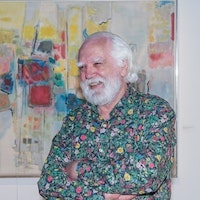
Pierre Gendron
Pierre Gendron Biography
Pierre Gendron was born in Montreal in 1934. He studied at the École des Beaux-Arts de Montréal under Jacques de Tonnancour, Albert Dumouchel, and Henry Eveleigh. After winning a Province of Quebec prize, Gendron traveled to Paris to study engraving. While in Paris in 1958, he exhibited at the Galerie du Haut Pavé. The following year, he exhibited in Montreal at the Galerie Agnès Lefort, and in 1960 at the Montreal Museum of Fine Arts.
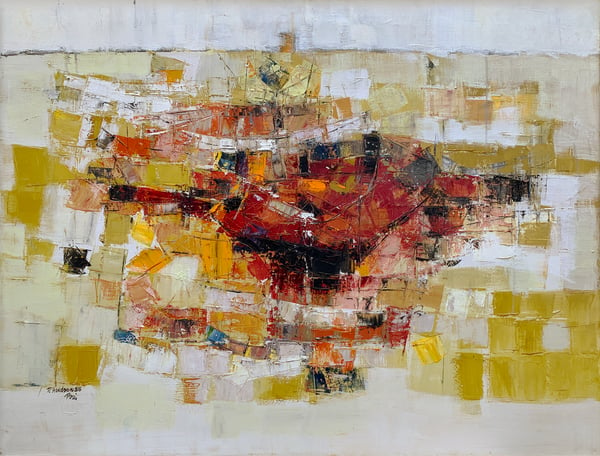
Gendron developed skills as both a graphic artist and painter, working in oils and gouaches. His non-objective paintings typically featured strong areas of red and orange tones contrasted with black and white. He became active with the Non-Figurative Artists' Association of Montreal, and in 1960 his work was selected for exhibition at the National Gallery of Canada in a show organized by Claude Picher, who was then the Gallery's Eastern Representative.
Critics noted Gendron's exploration of geometric forms while maintaining lyrical qualities in his work. His paintings displayed varied textures, achieved through the use of palette knife techniques that created relief effects, ranging from thick, smooth paint to transparent, woolly surfaces. Some observers noted symbol-like engraved elements in his work reminiscent of prehistoric monuments. His geometric constructions were offset by freer elements including wavy lines, creating an overall effect described as optimistic art with liberty in forms and color.
Gendron's work is represented in the collections of the National Gallery of Canada, the Montreal Museum of Fine Arts, and the Musée national des beaux-arts du Québec. He exhibited with the Royal Canadian Academy of Arts and the Canadian Group of Painters. Gendron lived in Montreal where he worked as an art teacher for the Catholic School Commission.