Toko Shinoda
1913 - 2021
Toko Shinoda Biography
1913 - 2021
Toko Shinoda was born on March 28, 1913, in Dairen, Kwantung Leased Territory (now Dalian, China), to Raijirō, a tobacco factory manager, and Jōko, a housewife. Her given name was Masuko, meaning "child of Manchuria," but she later adopted the artist name Tōkō, meaning "red peach flower." Her family moved to Tokyo in 1914, where she was raised. Her father, who had a deep appreciation for classical poetry, provided her first calligraphy instruction at age five and encouraged her intellectual development. In 1925, she entered a women's higher school, where she received formal calligraphy instruction from Setsudō Shimono and later studied tanka poetry composition with Ayako Nakahara. At age twenty-three in 1936, she left home against her family's wishes to earn a living teaching calligraphy, beginning her independent artistic career.
Shinoda's early professional work was met with harsh criticism from the traditional calligraphy establishment. Her first solo exhibition in 1940 at Kyūkyodō Gallery in Ginza featured her original short poems written in kana (Japanese syllabary), but critics dismissed her work as "rootless" for lacking a respectable classical foundation. This negative response reflected the gendered divisions within Japanese calligraphy, where women were expected to practice the "feminine" kana style with delicate qualities grounded in classical court literature. Shinoda's unorthodox approach, which presented original compositions rather than traditional forms, irritated the conservative establishment. Her career was suspended during World War II when she evacuated to Aizu, Fukushima, in 1941 and suffered from tuberculosis until her recovery in 1947.
After the war, Shinoda embraced the newfound freedom to pursue abstract expression, moving beyond traditional calligraphic constraints. She quickly established her abstract style using brushstrokes and ink splashes that employed various expressions, developing her mature artistic voice before her international recognition. During the 1950s, she built connections with modernist architects and received commissions for large-scale works, including murals for the Japan Pavilion designed by Kenzō Tange at the four-hundredth anniversary of São Paulo in 1954. Her work gained international attention when she was selected for the "Japanese Calligraphy" exhibition at the Museum of Modern Art in New York in 1954 and appeared in Pierre Alechinsky's art film "Calligraphie Japonaise" in 1955.
In 1956, at age forty-three, Shinoda embarked on a solo journey to the United States with an invitation from the Swetzoff Gallery in Boston. Through the assistance of painter Okada Kenzō, she secured her first New York solo exhibition at the Bertha Schaefer Gallery in January 1957. During her two-year stay, she held solo exhibitions in New York, Cincinnati, Chicago, Paris, and Brussels, quickly garnering international admiration. The famous photographer Hans Namuth documented her work process, and she spent time with leading figures of the Abstract Expressionist movement. However, she found the dry American climate unsuitable for ink painting and returned to Japan in May 1958, where she remained for the rest of her career.
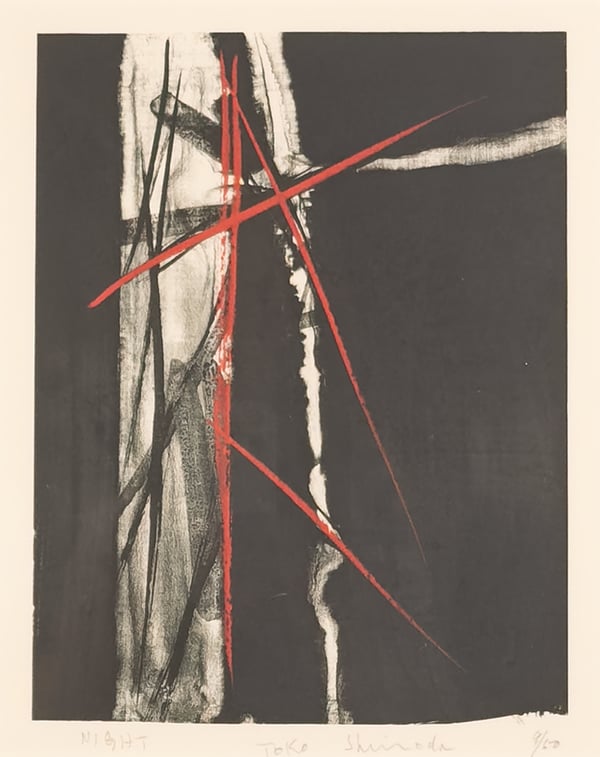
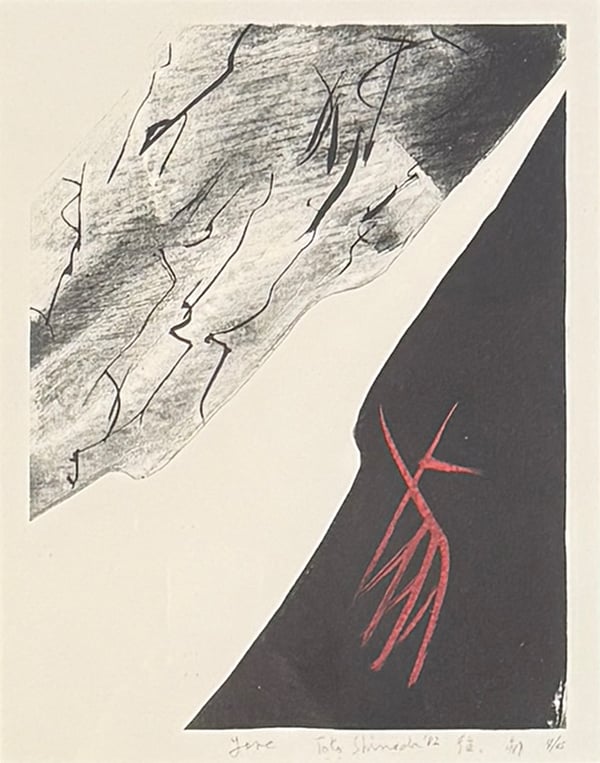
Upon her return to Japan, Shinoda established her mature style characterized by wide, bold lines including blurs, hazes, and subtle variations of tone within black fields that expressed the nature of ink. From 1960 onwards, she produced more than 1,000 lithographs, working exclusively with master printer Kihachi Kimura for nearly fifty years until his retirement in 2007. She continued to receive major architectural commissions throughout the 1960s, including work for buildings designed by prominent architects such as Kenzō Tange and Sachio Otani. Her international success continued with regular exhibitions at the Betty Parsons Gallery in New York from 1965 to 1977, and she became the first prominent woman artist in the field of calligraphy to achieve such recognition.
Shinoda remained active throughout her life, continuing to work until her death on March 1, 2021, at age 107. Her work is held in major international collections including the Metropolitan Museum of Art, the Museum of Modern Art in New York, the Guggenheim Museum, the British Museum, the Art Institute of Chicago, and the National Museum of Modern Art in Tokyo. She received significant recognition including the Japan Essayists' Club Award in 1979 for her book "Sumi iro" (The Colour of Sumi) and was honored with a commemorative postage stamp in 2016, making her the only Japanese artist to receive this recognition while still alive. The Toko Shinoda Art Space opened in Seki City, Gifu Prefecture, in 2003, and she was celebrated with a touring retrospective exhibition in 2013 for her 100th birthday. Beyond her artistic practice, Shinoda was a prolific writer, publishing more than twenty books throughout her career.