Sam Borenstein
1908 - 1969
Sam Borenstein Biography
1908 - 1969
Sam Borenstein was born on January 15, 1908, in Kalvarija, Lithuania, in the Russian Empire. He immigrated to Canada in 1921 with his father and one of his sisters, joining four of his brothers who were already living in Montreal. They were part of a massive wave of eastern European immigration to Canada in the early decades of the twentieth century, especially following World War I when the United States began restricting immigration of Jews and other eastern Europeans. After arriving, Borenstein spent two years in Ottawa as an apprentice to a furrier before returning to Montreal, where he worked as a cutter in a garment factory.
Although he had little formal training, Borenstein took evening art classes, studying sculpture with Elzéar Soucy and drawing with Adam Sheriff Scott and John Young Johnstone. He studied at the Council of Arts and Manufactures in Montreal around 1926-29 and briefly attended the Académie André Lhote in Paris in 1939. He associated with local Montreal artists including Alexandre Bercovitch, Fritz Brandtner, Herman Heimlich, and Louis Muhlstock. His first solo exhibition took place in 1934 at the Coffee House café in Montreal. In 1938, he saw the work of Chaïm Soutine at W. Scott & Sons in Montreal, which influenced his developing style.
During a six-month painting trip to Brittany in 1939, Borenstein had the opportunity to see the work of artists he had long admired, including Vincent van Gogh, and his painting became more focused. Within months of his return to Canada, he had a show at the Sidney Carter Art Gallery in Montreal and was invited to join the Contemporary Arts Society, with which he was affiliated from around 1939 to 1942. From the 1940s, he painted frequently in the Laurentians, and later painted on the New England coast in 1968.
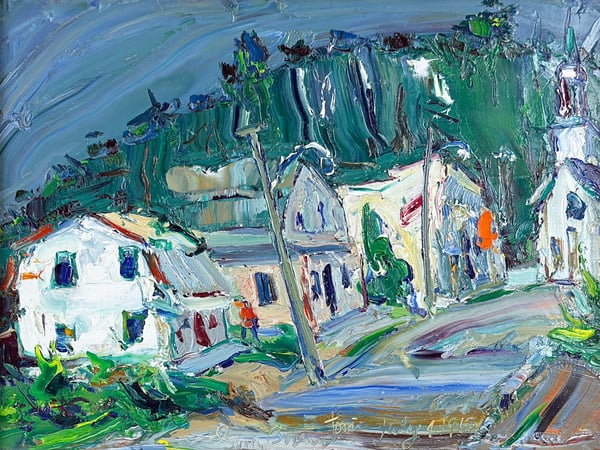
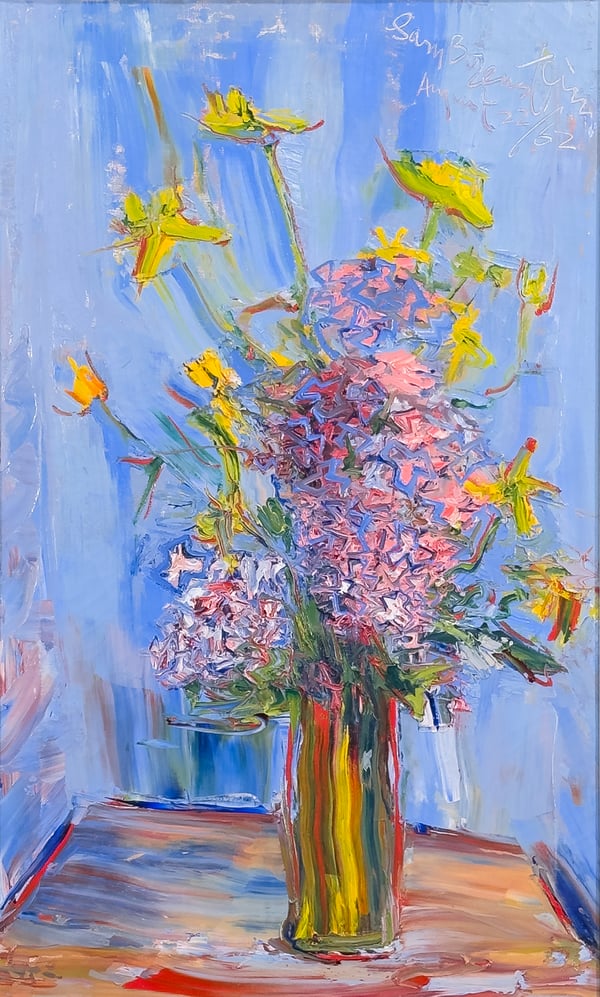
Borenstein approached painting with a distinctively modernist sensibility, rejecting traditional narrative and academic technique in favor of direct observation of the world and a free and expressive use of paint and color. His expressionist style was characterized by vivid colors, distorted perspective, exuberant brushwork, and a sense of movement that recalled the works of European masters he admired, especially Van Gogh, Vlaminck, Utrillo, and Soutine. A practitioner of plein air painting, he painted portraits and Montreal street scenes in the 1930s and 1940s, then shifted to street scenes, village and country landscapes in the 1950s and 1960s. His subjects included Depression-era Montreal, Laurentian villages, and Quebec landscapes bustling with human activity, as well as numerous portraits, still lifes, and flower paintings.
In 1966, three years before his death, Borenstein was the subject of a retrospective exhibition at the Art Gallery of Sir George Williams University (now Concordia University). He died on December 15, 1969. In 1992, his daughter Joyce Borenstein, a film animator and artist, produced an animated documentary titled "The Colours of My Father: A Portrait of Sam Borenstein," which was nominated for an Academy Award and won nine international film festival awards including a Genie for Best Short Documentary. In 2005, a major retrospective titled "Sam Borenstein: The Colours of Montreal" was held at the Montreal Museum of Fine Arts and toured across Canada. His work is held in collections including the National Gallery of Canada.