Sky Plain
56.5 x 56.5 in (143.5 x 143.5 cm) including frame
Ivan Eyre is widely regarded as one of Canada’s most distinctive figurative and landscape painters. Born in Tullymet, Saskatchewan, Eyre studied under Ernest Lindner in Saskatoon before attending the University of Manitoba School of Art, where he graduated in 1957, later joining the faculty as a professor of painting and drawing in 1959. Eyre’s early reputation was established through psychologically charged, figurative tableaux, enigmatic still lifes, and dense graphic drawings. By the 1970s and into the 1980s, landscape emerged as a central pillar of his practice, culminating in major survey exhibitions and the eventual establishment of the Ivan Eyre Gallery at Winnipeg’s Pavilion Gallery Museum. Rather than adopting the topographical naturalism common to Western Canadian regional art, Eyre approached the genre from an uncompromisingly conceptual and formalist perspective.
Measuring 56 by 56 inches, Sky Plain is a monumental example of Eyre’s mature landscape work of the mid-1980s. The canvas is structured as a series of stratified horizontal planes, ascending from a tangled, autumnal foreground of brush and foliage through undulating ridges of forest, scrubland, and expansive rolling terrain beneath a narrow, pale sky. Despite the legibility of its terrain, Eyre’s landscapes are not painted en plein air or derived from specific geographic locales; instead, they are synthetic studio compositions constructed entirely from memory, imagination, and formal intuition. Working from recollections of the Saskatchewan parkland and the Manitoba plains, Eyre extracts universal archetypes of space, distance, and geological structure.
This reliance on memory allows Eyre to prioritize the abstract architecture of the picture plane. Across Sky Plain, form dissolves into a complex tapestry of thousands of deliberate brush marks, stippled strokes, and interwoven color relationships. Fiery oranges and deep violets in the lower foreground give way to dense greens, chalky whites, and rhythmic bands of cool blues and greys stretching toward the horizon. Through this dense accumulation of mark-making, Eyre bridges the figurative tradition of Canadian landscape painting with modern abstract concerns, treating the vast prairie panorama as an intricate, meditative field of paint.


Ivan Eyre
1935 - 2022 RCA
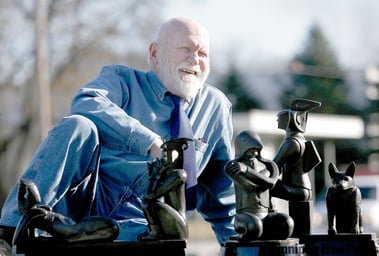
Ivan Kenneth Eyre was a Canadian painter and sculptor known for his striking prairie landscapes, complex figurative compositions, and deep explorations of personal mythology. Born in Tullymet, Saskatchewan, Eyre demonstrated an early interest in art, studying under Ernest Lindner and Eli Bornstein. He completed his Bachelor of Fine Arts at the University of Manitoba in 1957 and later attended the University of North Dakota. In 1959, he returned to Winnipeg to teach at the University of Manitoba, where he remained a professor of painting and drawing for over three decades until his retirement in 1993.
Eyre's artistic output spanned more than fifty years, during which he developed a distinctive style characterized by meticulous detail, imaginative landscapes, and psychological complexity. His paintings often juxtaposed vast, panoramic environments with silhouetted figures or abstracted forms, creating an enigmatic visual tension. He rejected realism in favor of what he called "invented landscapes," dreamlike spaces that evoked memory and emotion rather than geographical accuracy. His figurative works frequently included symbolic elements, reinforcing a sense of mystery and introspection.
His impact on Canadian art was significant, earning him numerous accolades, including membership in the Royal Canadian Academy of Arts (1974), the Order of Manitoba (2007), and the Order of Canada (2015). His work has been exhibited extensively, with solo and group exhibitions across Canada and internationally. Major institutions such as the National Gallery of Canada, the Winnipeg Art Gallery, and the McMichael Canadian Art Collection house his paintings and sculptures.
One of Eyre’s most substantial contributions to the Canadian art landscape was his generous donation of over 200 paintings, 5,000 drawings, and 16 sculptures to the Pavilion Gallery at Assiniboine Park in Winnipeg. The Ivan Eyre Gallery, dedicated to showcasing his work, remains a significant cultural site. Additionally, his large-scale bronze sculptures are displayed at institutions such as the McMichael Canadian Art Collection and in public spaces across Canada.
Eyre’s philosophy on art emphasized the necessity of ambiguity and personal interpretation. He believed that a painting should not reveal everything at once but instead offer an ongoing dialogue with the viewer. His work continues to inspire artists and collectors, solidifying his legacy as a pivotal figure in Canadian art history. His influence extends beyond his paintings and sculptures, as many of his former students have become significant artists in their own right, contributing to the evolution of contemporary Canadian art.
Ivan Eyre passed away in November 2022, leaving behind a body of work that remains an enduring testament to his creative vision and dedication to artistic exploration.