Cow Cup
During the early 1970s at the University of Saskatchewan’s Regina Campus, Joe Fafard and fellow faculty members David Gilhooly and Victor Cicansky engaged directly with the ethos of Regina Clay, often blurring the boundaries between domestic functional pottery and figurative sculpture. While Fafard rapidly established his reputation through portrait busts and freestanding animal figures, his early sculptural vessels investigated utilitarian pottery archetypes—most notably the cup and the jug—integrating animal anatomy into the vessel’s structural body.
In Cow Cup, Fafard fuses a cylindrical vessel with a cluster of recumbent cows resting on an irregular, textured ground. Rather than functioning merely as decorative surface relief, the sculpted cattle form an integral part of the vessel's architecture, clustering around its base while textured, nodular forms emerge along the upper right rim to serve as an organic handle. The entire work is finished in a uniform, high-reflective metallic lustre glaze, lending the piece a patinated, near-bronze tonality that anticipates Fafard's later turn to metal casting in the 1980s. Combining ceramic tradition with regional subject matter, the work exemplifies the subversive wit and technical experimentation of Fafard's early sculptural vessels.


Joe Fafard
1942 - 2019 Order of Canada, RCA
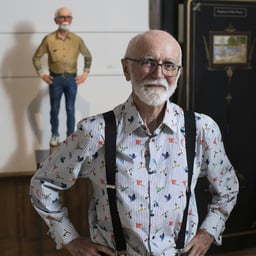
Nationally and internationally acclaimed artist Joe Fafard was born to French-Canadian parents in the small agricultural community of Ste. Marthe, Saskatchewan. He attended both the University of Manitoba (BFA 1966) and Pennsylvania State University (MFA 1968). He was at the University of Saskatchewan, Regina from 1968 to 1974 and visiting lecturer at the University of California at Davis in 1980 1981.
Fafard was one of Canada’s leading professional visual artists and exhibited a wide variety of work across the country and around the world. He was recognized as being at the forefront of his art and he significantly raised the profile of both Saskatchewan and Canada on the international stage. He was named an Officer of the Order of Canada in 1981; received the Saskatchewan Order of Merit in 2002; received the National Prix Montfort in 2003; and in 2005, the Lieutenant Governor’s Saskatchewan Centennial Medal for the Arts.
In the early 1970s much of his sculpture used clay as a medium. In 1985 he shifted to bronze as his chief sculptural medium, successfully establishing a foundry in Pense. His insight and humour characterized his portraits of neighbours, farm animals, and famous artists that he came to respect as he learned his craft.
More work by Joe Fafard