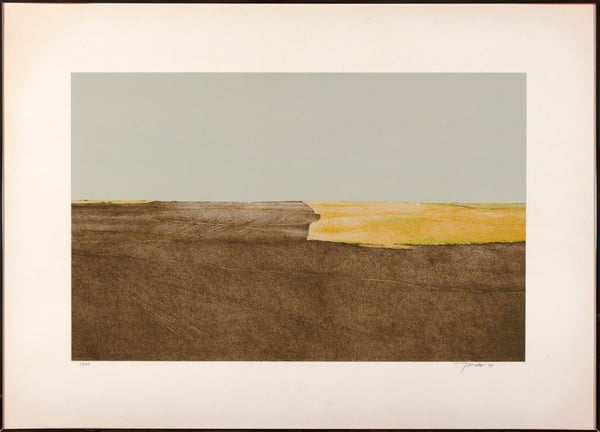
Spanish Banks
21.75 x 32 x 0.75 in (55.2 x 81.3 x 1.9 cm) including frame
Depicting the low-tide flats and sweeping horizons of Vancouver’s outer shores, Spanish Banks exemplifies Takao Tanabe’s mastery of coastal atmospheric perspective. Through thinly layered planes of muted tone, Tanabe strips the view of temporal detail, balancing modernist formal restraint with a quiet, contemplative evocation of the Pacific coastline.


Takao Tanabe
RCA, CM, OBC
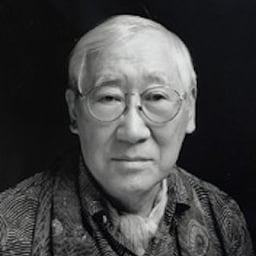
Takao Tanabe, CM, OBC, RCA (born 1926), was born in Seal Cove, British Columbia, to Japanese immigrant parents. In 1937, his family relocated to Vancouver. Following the invocation of the War Measures Act in 1941, Tanabe and his family were forcibly displaced in 1942 and interned at Lemon Creek in southeastern British Columbia. In 1944, restricted from returning to the Pacific coast, he moved to Winnipeg to work as a farm laborer, foundry worker, and warehouse clerk. Seeking technical employment training, he enrolled in evening classes at the Winnipeg School of Art in 1946, progressing to full-time study from 1946 to 1949 under the mentorship of artist Joseph Plaskett. Tanabe continued his formal training at the Brooklyn Museum Art School in New York from 1951 to 1952 with Hans Hofmann and Reuben Tam, followed by studies at the Central School of Arts and Crafts in London from 1953 to 1954 on an Emily Carr Scholarship. Between 1959 and 1961, a Canada Council grant supported his studies in traditional sumi-e ink painting and single-stroke Zen calligraphy under Ikuo Hirayama and Yanagida Taiun at the Tokyo University of the Arts.
From 1961 to 1968, Tanabe taught at the Vancouver School of Art, serving as head of the commercial art department while completing large-scale public mural commissions across Canada. In 1968, he relocated to the United States, working in Philadelphia before establishing a studio in New York City from 1969 to 1972, where his practice centered on hard-edge geometric abstraction. In 1973, Tanabe returned to Canada to become head of the art department and artist-in-residence at the Banff Centre for the Arts in Alberta, a position he held until 1980. That year, he relocated permanently to Vancouver Island, British Columbia, to dedicate himself exclusively to studio painting.
Tanabe's painting style evolved from calligraphic gestural abstraction and hard-edge geometric canvases into minimalist landscape representations. During his tenure at Banff, he initiated his influential prairie series, applying the disciplined spatial economy of color-field abstraction to the Western Canadian terrain. Working without primer to seal his supports, he applied thin acrylic washes directly onto raw canvas, requiring immediate, precise brushwork akin to traditional ink techniques. These compositions dismantled conventional regionalist landscape conventions by paring vistas down into flat, horizontal bands of color and light while omitting man-made markers such as roads, telephone lines, and grain elevators. Following his return to the West Coast, he carried this spare aesthetic into coastal seascapes characterized by low horizons, expanses of water and sky, and subdued atmospheric conditions.
Tanabe was elected to the Royal Canadian Academy of Arts and appointed a Member of the Order of British Columbia in 1993, followed by appointment as a Member of the Order of Canada in 1999. He received the Governor General's Award in Visual and Media Arts in 2003 and the Audain Prize for Lifetime Achievement in the Visual Arts in 2013. In 2005, a major retrospective of his work organized by the Vancouver Art Gallery and the Art Gallery of Greater Victoria toured nationally to institutions including the McMichael Canadian Art Collection in Kleinburg and the Art Gallery of Nova Scotia in Halifax. His paintings and prints are held in permanent public collections, including the National Gallery of Canada in Ottawa, the Vancouver Art Gallery, the Art Gallery of Ontario in Toronto, the Glenbow Museum in Calgary, and the Tate Collection in the United Kingdom.
More work by Takao Tanabe