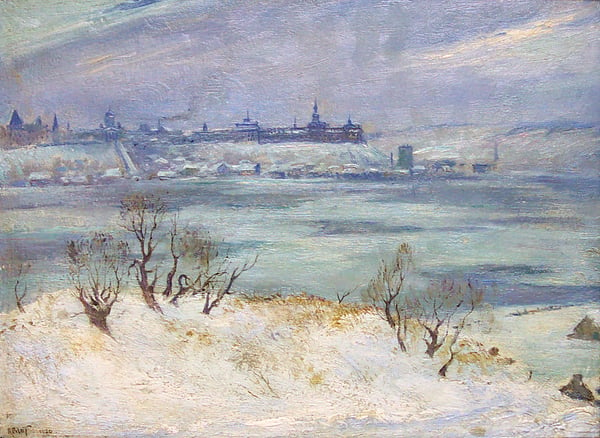
The Skating Rink, Port Saint Louis, Quebec
33 x 41 in (83.8 x 104.1 cm) including frame
Robert Pilot holds an enduring place in Canadian art history as one of the country's foremost proponents of Impressionism. Raised in an environment steeped in artistic discipline—mentored by his stepfather, Maurice Cullen, and later trained at the Académie Julian in Paris—Pilot developed an approach to painting that synthesized French Impressionist atmospheric sensitivity with the distinct conditions of the Canadian climate. In his final decade, Pilot produced a body of mature, fully realized works where compositional balance, subtle light, and refined paint application reached complete resolution.
Painted in 1966, The Skating Rink, Porte Saint-Louis, Quebec epitomizes the artist’s mature mastery. Throughout his career, Quebec City served as Pilot's primary muse; its stone fortifications, French colonial architecture, and dramatic elevations provided an ideal architectural framework for his atmospheric studies. Here, the historic battlements and rooftops near the Porte Saint-Louis recede gently behind snow-laden trees, grounding the work in the layered topography of Old Quebec.
Skating scenes represent a rare and particularly celebrated thematic category within Pilot’s oeuvre. While many of his urban vistas focus on quiet streets observed under falling snow or twilight, this composition introduces communal vitality into a winter landscape. The frozen oval rink is active with skaters gliding across the pale green ice, surrounded by clustered spectators in winter coats along the snowbanks and wooden boards.
Pilot’s handling of space directly reflects the influence of Camille Pissarro, whose elevated perspectives and structured boulevards balanced urban dynamism with compositional equilibrium. Though conveying the immediate spontaneity and crisp freshness of plein air observation, the canvas is an orchestrated studio work. Pilot organizes the composition through a harmonious distribution of figures, counterbalancing the curve of the rink with the verticality of bare winter branches and the distant spire piercing a soft, overcast sky. His control of northern winter light is rendered through a nuanced tonal palette of soft blues, slate greys, creams, and warm rose undercurrents, capturing the calm, diffuse glow of a cold Quebec afternoon.


Robert Pilot
1898 - 1967 RCA
More work by Robert Pilot