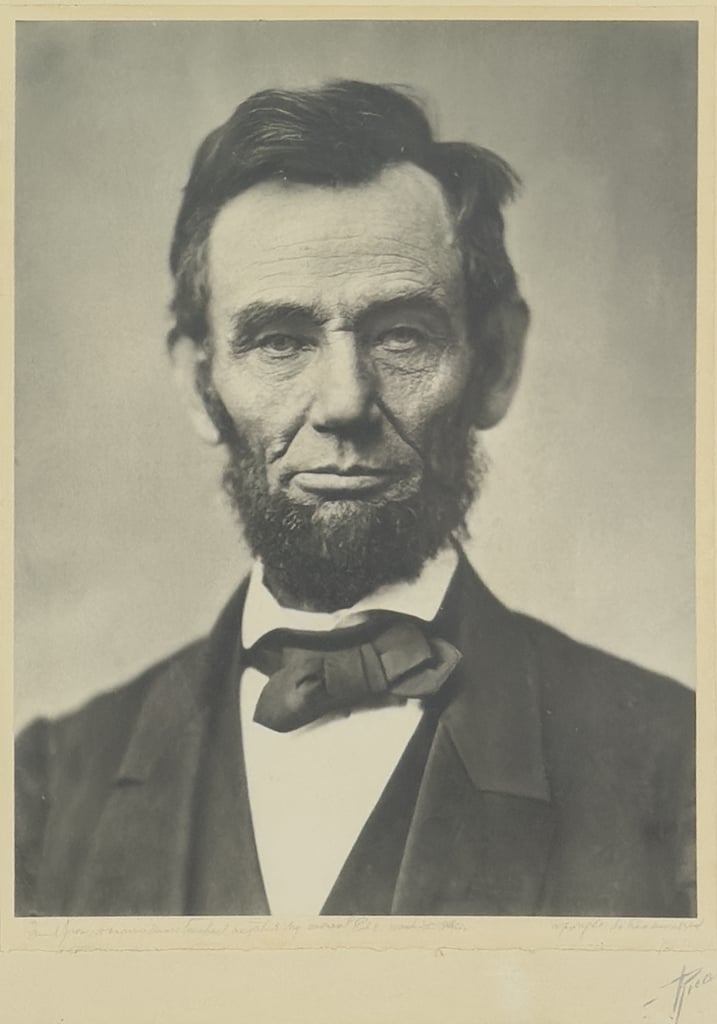
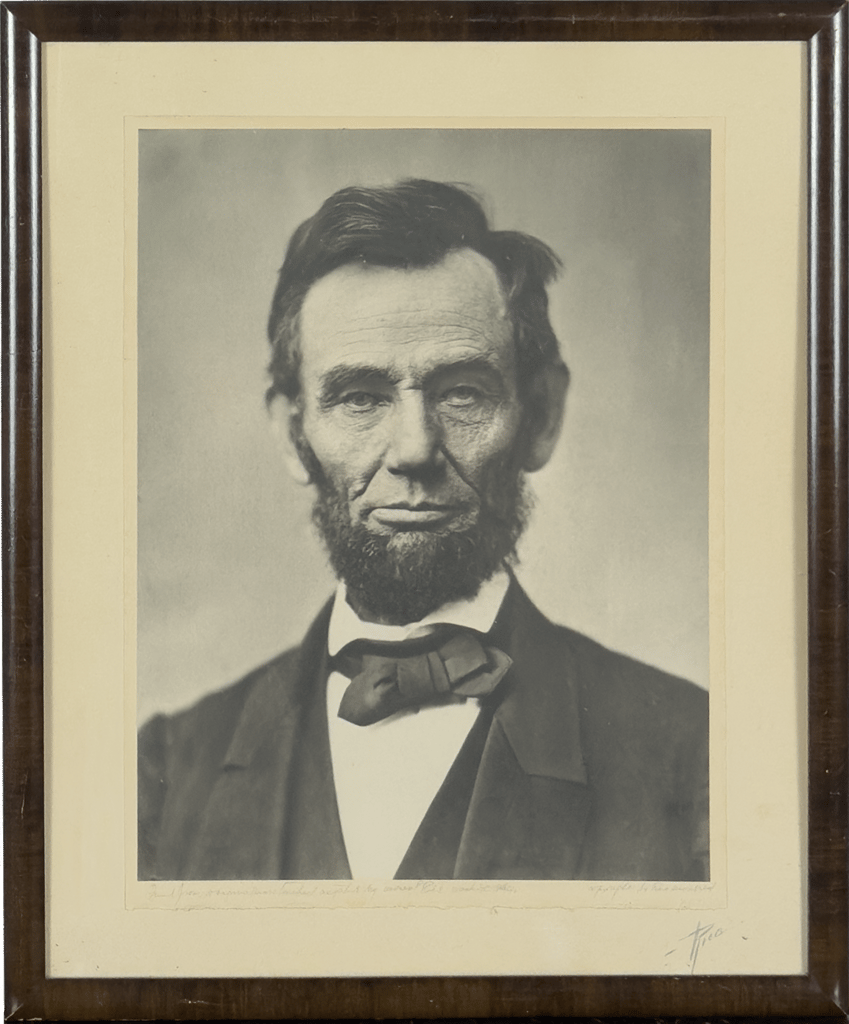
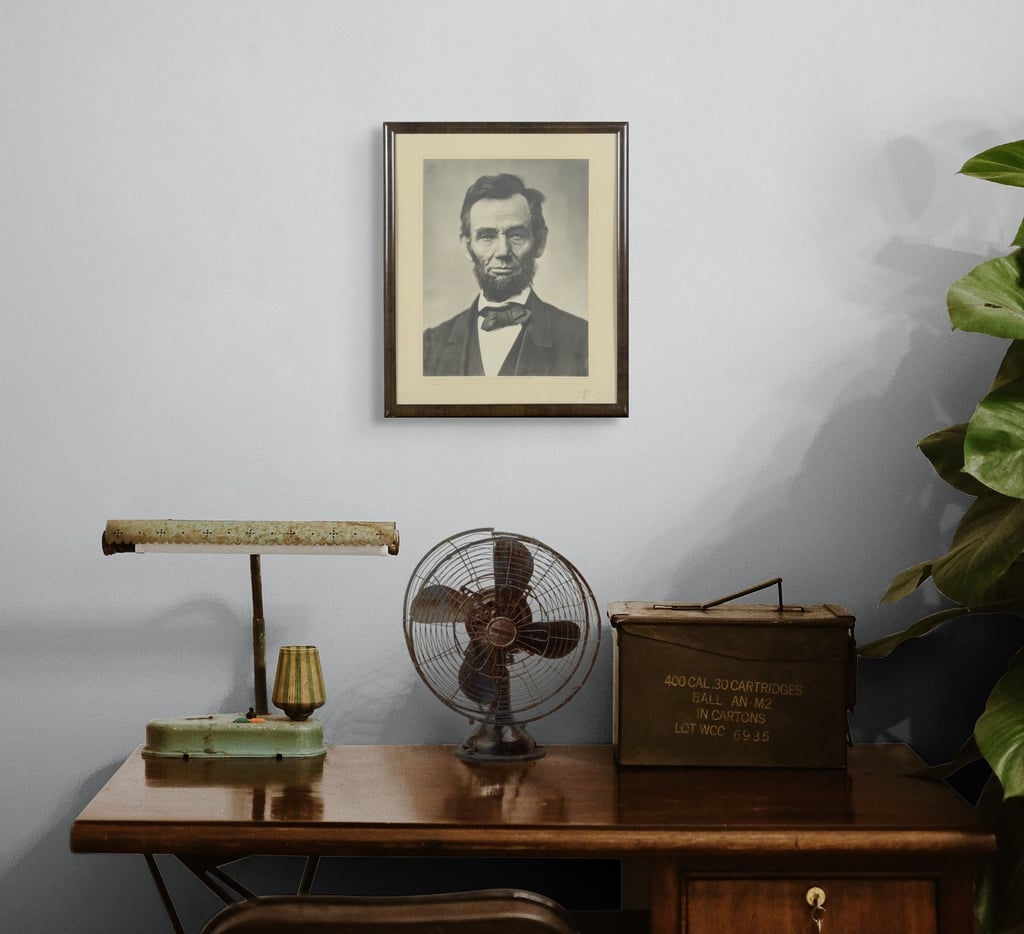
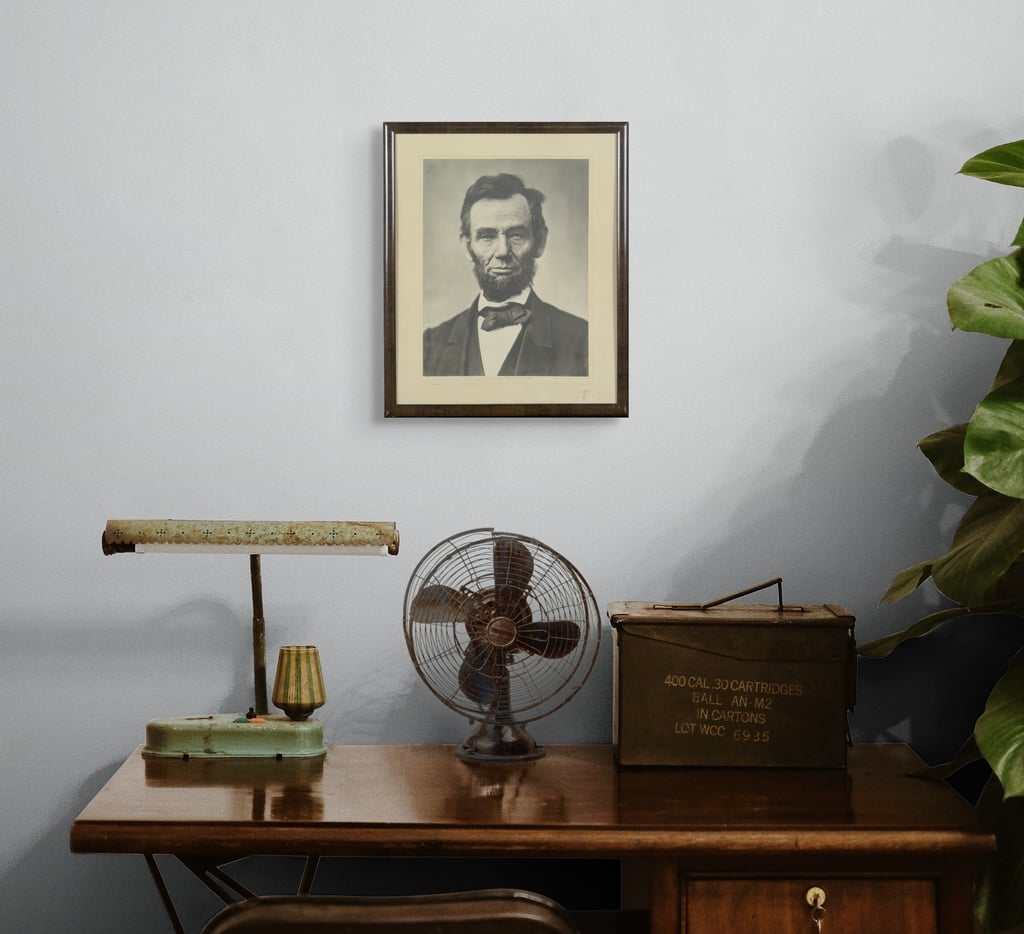
Abraham Lincoln Portrait (1863)
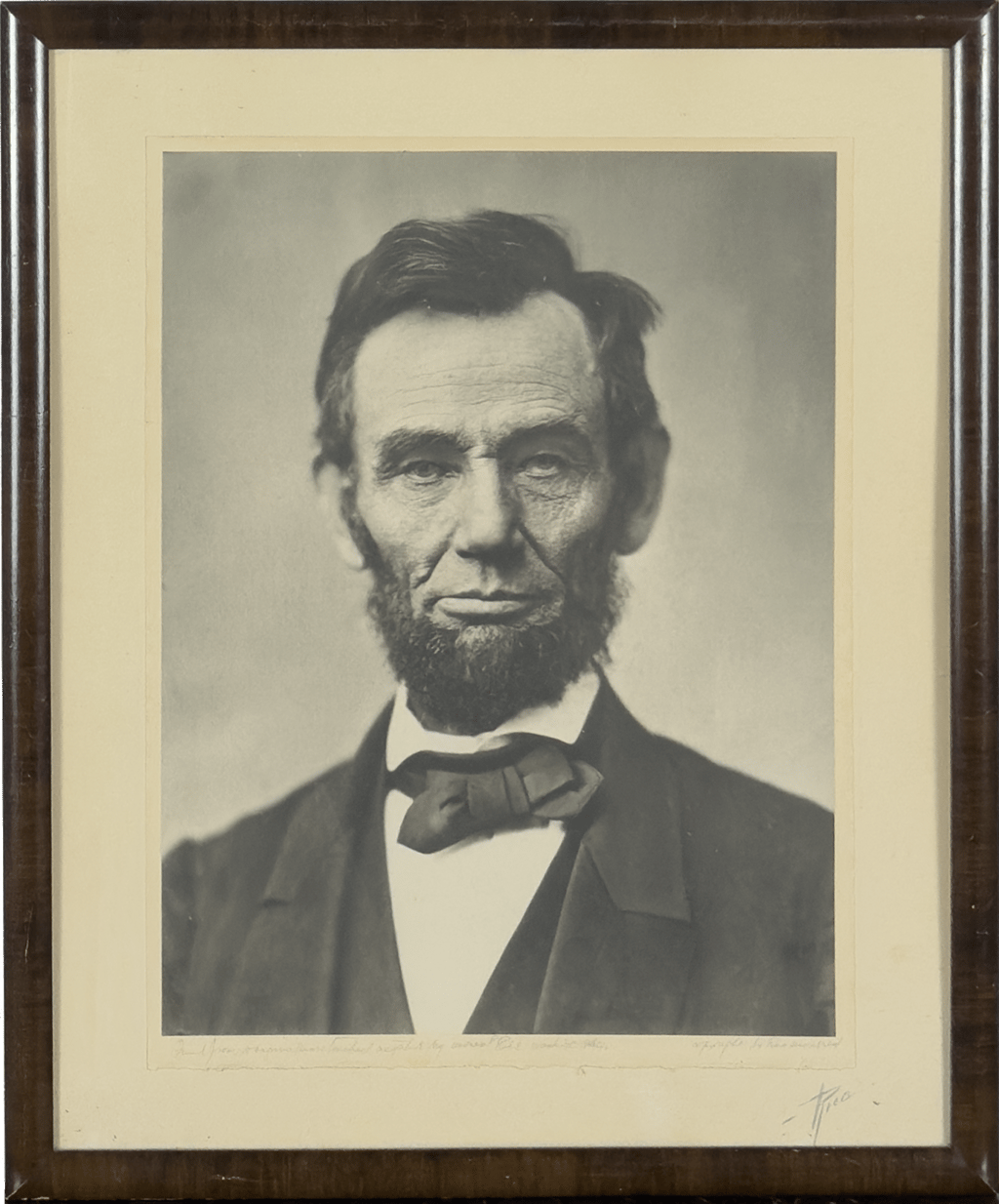
18 x 15 in (45.7 x 38.1 cm) including frame
This gelatin silver print reproduces Alexander Gardner's iconic "Gettysburg" portrait of President Lincoln, taken in mid-November 1863. The photograph is notable for capturing Lincoln's unretouched appearance, including his gaunt features, prominent mole, and asymmetrical left eye that art historian Harold Holzer described as giving the president a "mysterious" quality. Gardner's closely cropped composition became one of the most recognizable Lincoln portraits, later serving as the reference for Daniel Chester French's Lincoln Memorial sculpture.
This particular print was created by Moses P. Rice from a copy negative he made around March 1864, during Grant's promotion to Lieutenant General. Rice, who operated a Washington D.C. studio starting in 1865, copyrighted Gardner's original negative in 1891 and continued producing prints from his copy negative into the 1920s. The print represents an authentic reproduction of one of the most psychologically compelling Lincoln photographs, showing the president without the typical retouching that photographers like Mathew Brady often applied to soften his famously homely features.
Moses P. Rice
1839-1925
Moses Parker Rice was a Canadian-born photographer who played a notable role in American Civil War-era photography. Born in North Sydney, Cape Breton, to Robert Muckford Rice and Sarah Maria Ingraham, he arrived in Washington D.C. in 1861 and worked as a clerk before establishing himself as a photographer by 1865. Rice worked with Alexander Gardner during the Civil War period and made copy negatives of Gardner's photographs, including the famous "Gettysburg" portrait of Abraham Lincoln taken in November 1863. In 1891, Rice copyrighted several of Gardner's original negatives, a practice that was not uncommon during that era of photography.
Rice married Mary Ellen Graham in February 1865 and had eleven children. He operated photography studios in Washington D.C. for over five decades, initially partnering with his younger brother Amos Ingraham Rice (1850-1912) at various Pennsylvania Avenue locations before settling at 1203 F Street NW. The Rice brothers also established Rice Studios Limited in Montreal. Moses continued printing photographs from his Civil War-era negatives well into the 1920s. After becoming less active around 1924, the family business was managed by his son Robert C. Rice until it closed around 1930.