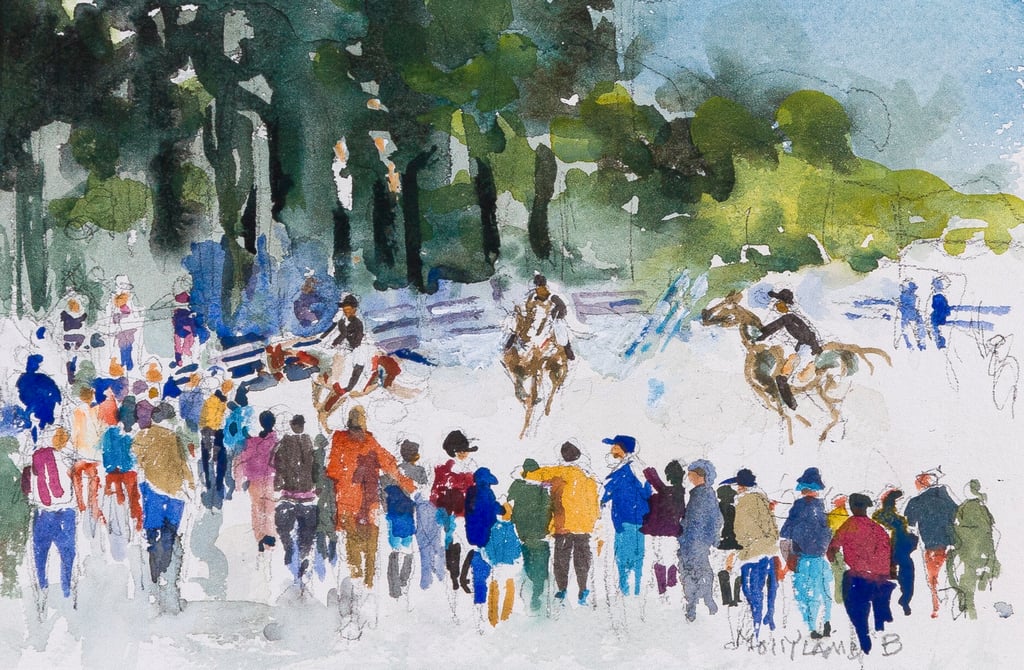
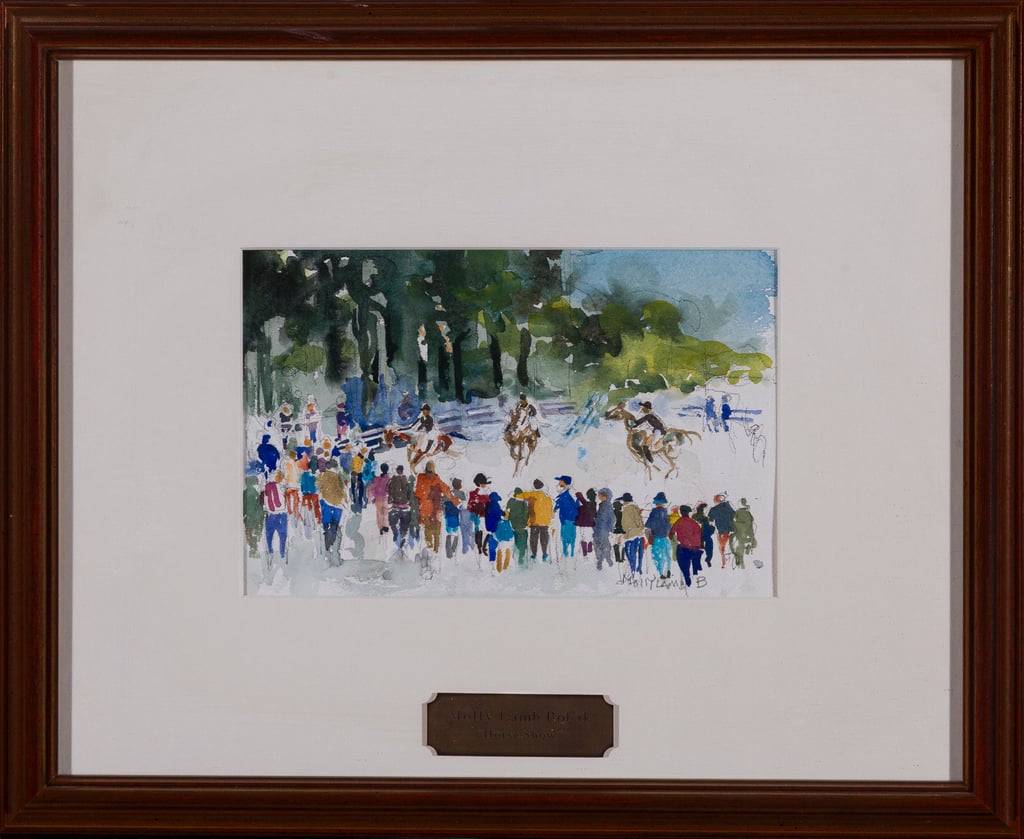
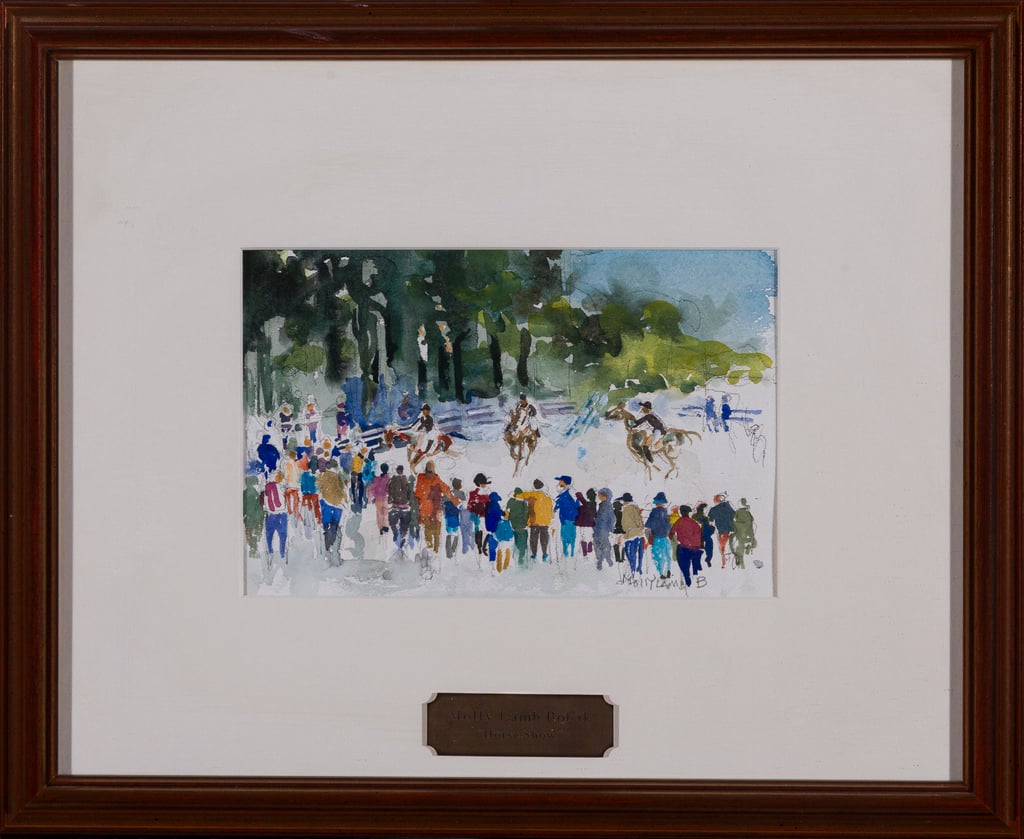
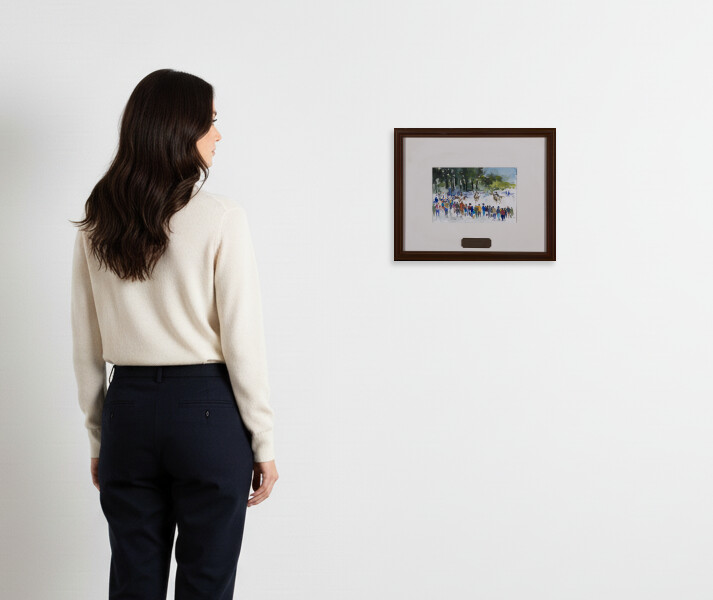
Horse Show
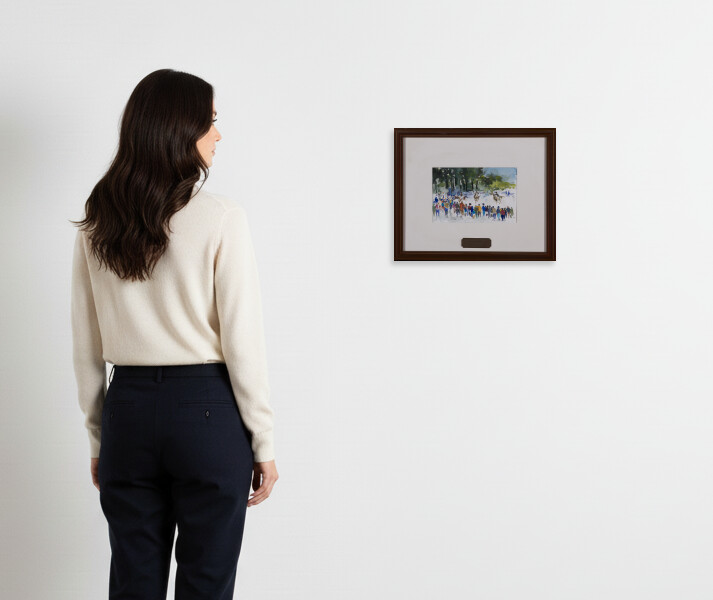
13.5 x 16.5 in (34.3 x 41.9 cm) including frame
Provenance:
Galerie Walter Klinkhoff, Montreal;
Mayberry Fine Art, Winnipeg
Molly Lamb Bobak
1920 - 2014 CM ONB RCA
Molly Lamb Bobak was born on February 25, 1920, on Lulu Island near Vancouver, British Columbia. Her father, Harold Mortimer-Lamb, was a mining engineer, photographer, journalist, art critic, and collector who befriended artists of the Group of Seven, who occasionally visited the family. Bobak grew up in an unconventional household where her mother, Mary Williams, who had initially worked as a housekeeper for Mortimer-Lamb, eventually moved in with him, his wife, and their children, forming an extended family. After his wife's death, Mortimer-Lamb married Vera Weatherbie, a former student and lover of Frederick Varley.
Bobak's poor eyesight and difficulties in school led her mother to encourage enrollment at the Vancouver School of Art, where she studied for four years with Jack Shadbolt and Charles Hepburn Scott, followed by an additional year of graduate studies. Shadbolt became a lifelong mentor who introduced her to European artists such as Cézanne and Matisse. Inspired by A.Y. Jackson's service as a war artist in World War I, Bobak enlisted in the Canadian Women's Army Corps in 1942 and served for four years.
From the beginning of her army service, Bobak kept an illustrated diary documenting C.W.A.C. life, spanning November 1942 to September 1945. The diary was created in the form of a broadsheet newspaper with handwritten material, drawings, and often self-deprecating commentary. A.Y. Jackson recognized the diary as demonstration of her potential as a war artist. In 1945, three years after enlisting, Bobak was appointed by the Canadian War Artists Selection Committee as Canada's first female official war artist. She was sent to London, England six weeks after V-E Day to document the Communications Units, crowd scenes, and celebrations marking the end of the war. Among her significant works as an official war artist is "Private Roy" (1946), one of the few depictions of Canadian soldiers of color created as part of the Canadian War Records program, portraying Sergeant Eva May Roy. There are over 400 of her works in the Canadian War Memorials Collection. In 1992, Dundurn Press published "Double Duty: Sketches and Diaries of Molly Lamb Bobak Canadian War Artist," and in 2015, Library and Archives Canada digitized all 226 pages of her diary.
After the war, Bobak married fellow war artist Bruno Bobak, whom she had met in London. They settled in Vancouver and had two sons, Alexander and another child. She taught painting at the Vancouver School of Art and night courses while raising her children. In 1950, she received a French Government Scholarship to study in France, where she encountered the works of modernist painters, particularly Cézanne, whose influence can be seen in the geometric organization of her subsequent work. Throughout the late 1950s, the Bobaks spent time in Europe with funding from the Canada Council.
Alan Jarvis, Director of the National Gallery of Canada, invited her to participate in exhibitions including the São Paulo Biennial and the Vancouver Art Gallery's Third Canadian Biennial in 1960. In 1960, the Bobaks moved to Fredericton, New Brunswick, where Bruno had been offered a position as resident artist at the University of New Brunswick. Molly continued to teach at various institutions throughout her life as a sessional and guest instructor.
Bobak was elected to the Royal Canadian Academy of Arts in 1973. In 1993, the MacKenzie Art Gallery in Regina, Saskatchewan organized a major touring retrospective of her work that traveled to Ottawa, St. John's, and Fredericton. She received the Order of Canada in 1995 and the Order of New Brunswick in 2002. She was among the first generation of Canadian women artists to work professionally and earn a living from their art.
Bobak is most widely recognized for her depictions of crowds and her World War II work. Her paintings of crowded scenes document public events and celebrations, capturing the dynamic, constantly changing rhythm of people gathering together. Though she favored watercolours, she also worked in oils, conte, and charcoal, working in an impressionistic style focused on capturing the essence of scenes rather than details. Her work is held in collections including the National Gallery of Canada, Canadian War Museum, Art Gallery of Greater Victoria, Glenbow Museum, Beaverbrook Art Gallery, and Art Gallery of Alberta. Bobak continued to paint and draw daily until age 84 when her eyesight deteriorated. She died in Fredericton on March 2, 2014, at age 94. She was the last surviving member of the 32 official Canadian war artists from World War II.