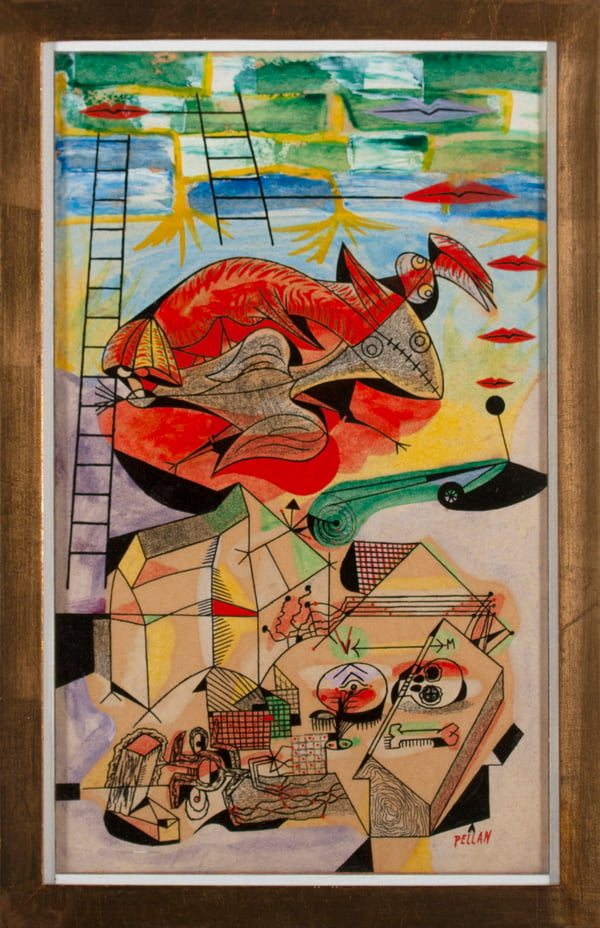
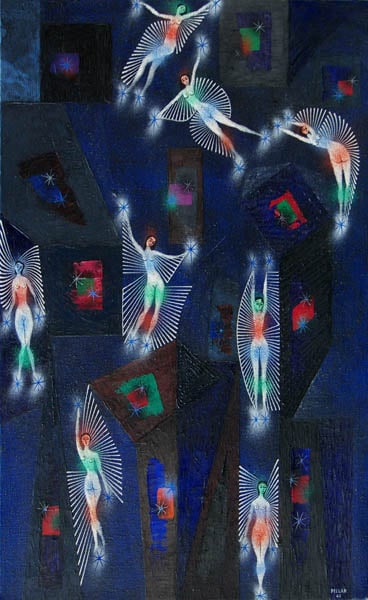
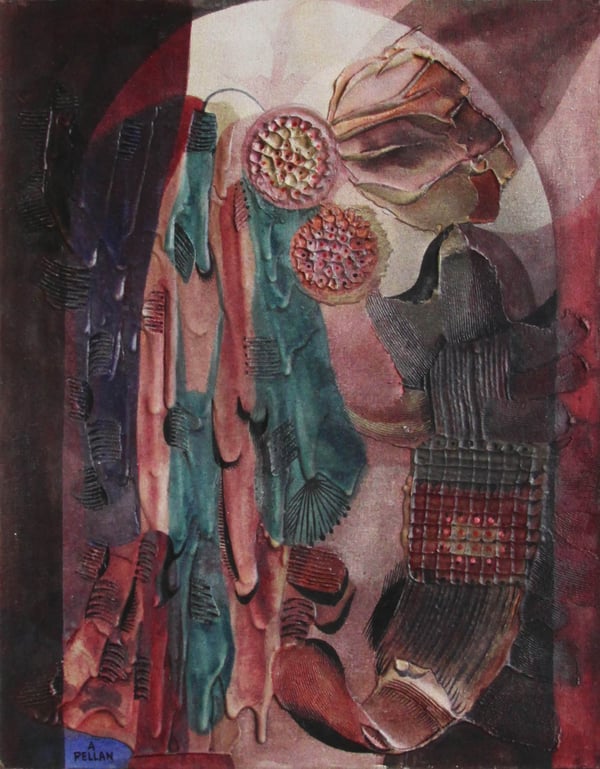
Chasse aux papillons
28 x 43 x 2 in (71.1 x 109.2 x 5.1 cm) including frame
Alfred Pellan was a central figure in modern Canadian art whose work merged European Surrealism, Cubism, and vibrant graphic figuration. Following extensive periods in Paris and a pivotal role in the Montreal avant-garde as the founder of the Prisme d'yeux group in 1948, Pellan developed a distinctive visual vocabulary characterized by rich textures, dreamlike imagery, and dense, cloisonné-like compartmentalization. By the late 1950s and early 1960s, his work increasingly integrated tactile mixed media—such as silica and textured pastes—with luminous color fields and intricate surface patterning.
Executed in 1961, Chasse aux papillons (Butterfly Hunt) presents a narrative landscape filled with biomorphic forms and layered optical elements. Near the center, a hat-wearing figure stands atop a ladder positioned behind a white paddock fence, raising a net to pursue a stylized, floating creature. The lower register is populated by upright, plant-like forms rendered in high-keyed pinks, greens, and reds with dotted borders, set against a riverbank where a smoking steamship navigates the water to the right. Overhead, heavy, marblized cloud masses frame the sky, joined by a small bridge trestle. At the upper edge, positioned directly along the central axis, a concentric polychrome orb evokes the target-like optical compositions explored by Montreal contemporary Claude Tousignant during the same era. Combining linear detail, sculptural paint application, and a bold chromatic range, the composition balances structured geometry with Pellan's playful, surrealist sensibility.


Alfred Pellan
1906 - 1988 RCA, CC
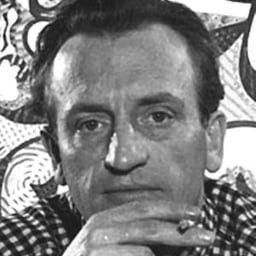
Alfred Pellan was a transformative figure in 20th-century Canadian painting and a pioneer of modern art in Quebec. Born in Quebec City on May 16, 1906, he began his formal art training at the École des beaux-arts de Québec at the age of 14. His early talent was recognized early, and in 1923, at the age of 17, the National Gallery of Canada acquired one of his paintings. In 1926, Pellan became the first recipient of the Quebec government's fine arts scholarship, which allowed him to pursue further studies at the École nationale supérieure des beaux-arts in Paris.
During his time in France, which lasted from 1926 to 1940, Pellan fully engaged with the European avant-garde. He studied the works of Surrealists, Cubists, and Fauvists, incorporating their vibrant palettes, fractured forms, and non-figurative elements into his own practice. He participated in the Parisian art scene, exhibiting alongside renowned international artists. The outbreak of World War II in 1940 compelled him to return to Montreal, where he introduced a radical modern aesthetic that challenged the conservative artistic conventions of the time.
Upon his return, Pellan became an influential educator at the École des beaux-arts de Montréal, where he advocated for artistic innovation and freedom. In 1948, he was a key signatory of the Prisme d'yeux manifesto, which called for artistic independence and an opening toward international modernism. Throughout the 1940s and 1950s, he expanded his practice beyond painting to include book illustration, costume and set design for the theatre, and mural commissions. In 1952, a research fellowship from the Royal Society of Canada enabled a second period in Paris, which culminated in a major solo retrospective of his work at the Musée d'Art moderne de la Ville de Paris in 1955.
Pellan’s career was marked by numerous honors and institutional recognition. He was named a Companion of the Order of Canada (CC) in 1967 and was a member of the Royal Canadian Academy of Arts (RCA). His work remains a staple of Canadian art history, characterized by its imaginative synthesis of Surrealist and abstract influences. Alfred Pellan died on October 31, 1988, in Laval, Quebec. His work is held in the permanent collections of major public institutions, including the National Gallery of Canada and the Musée national des beaux-arts du Québec.