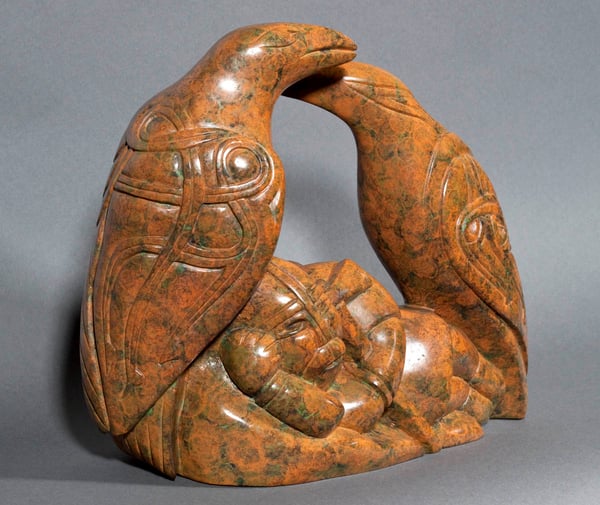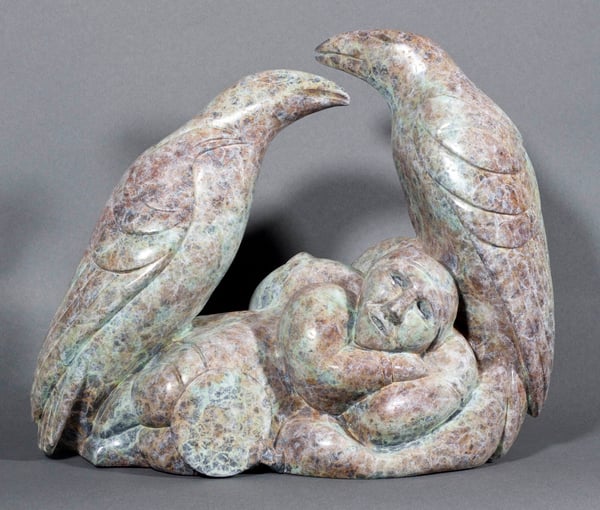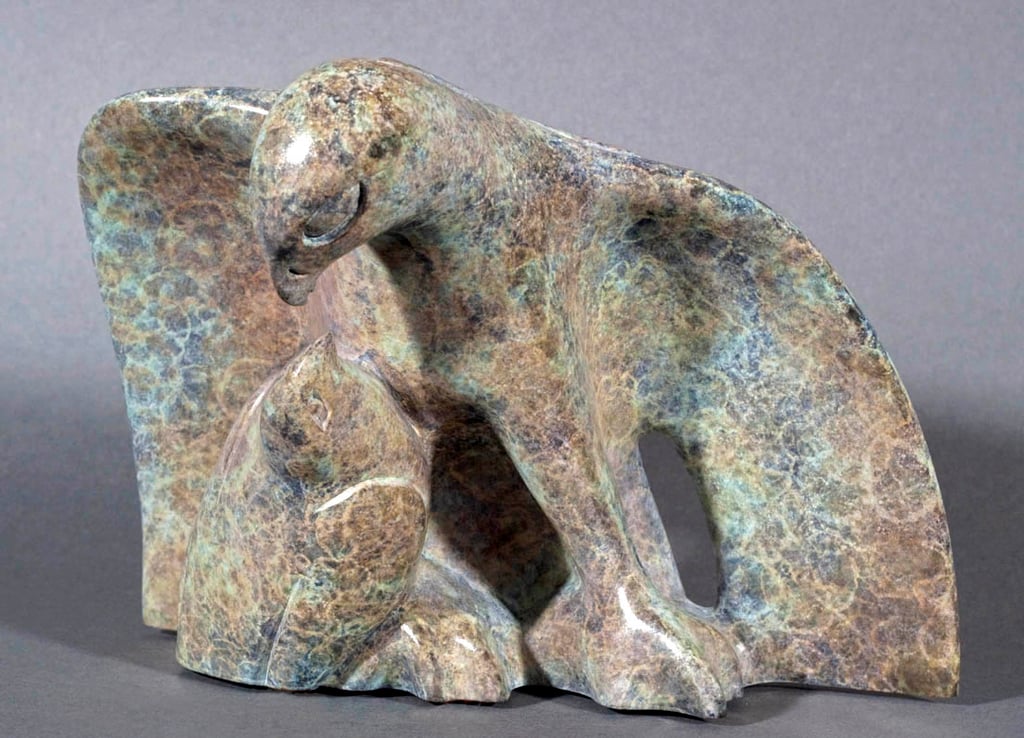
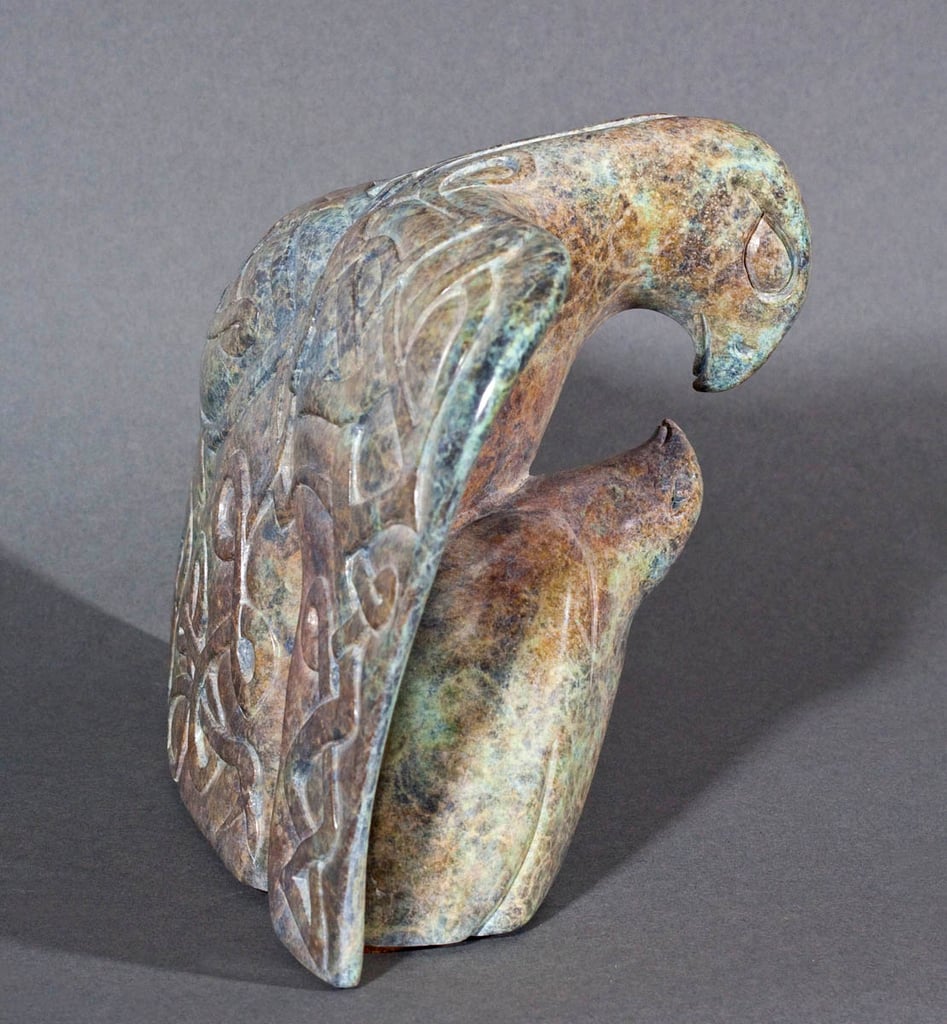
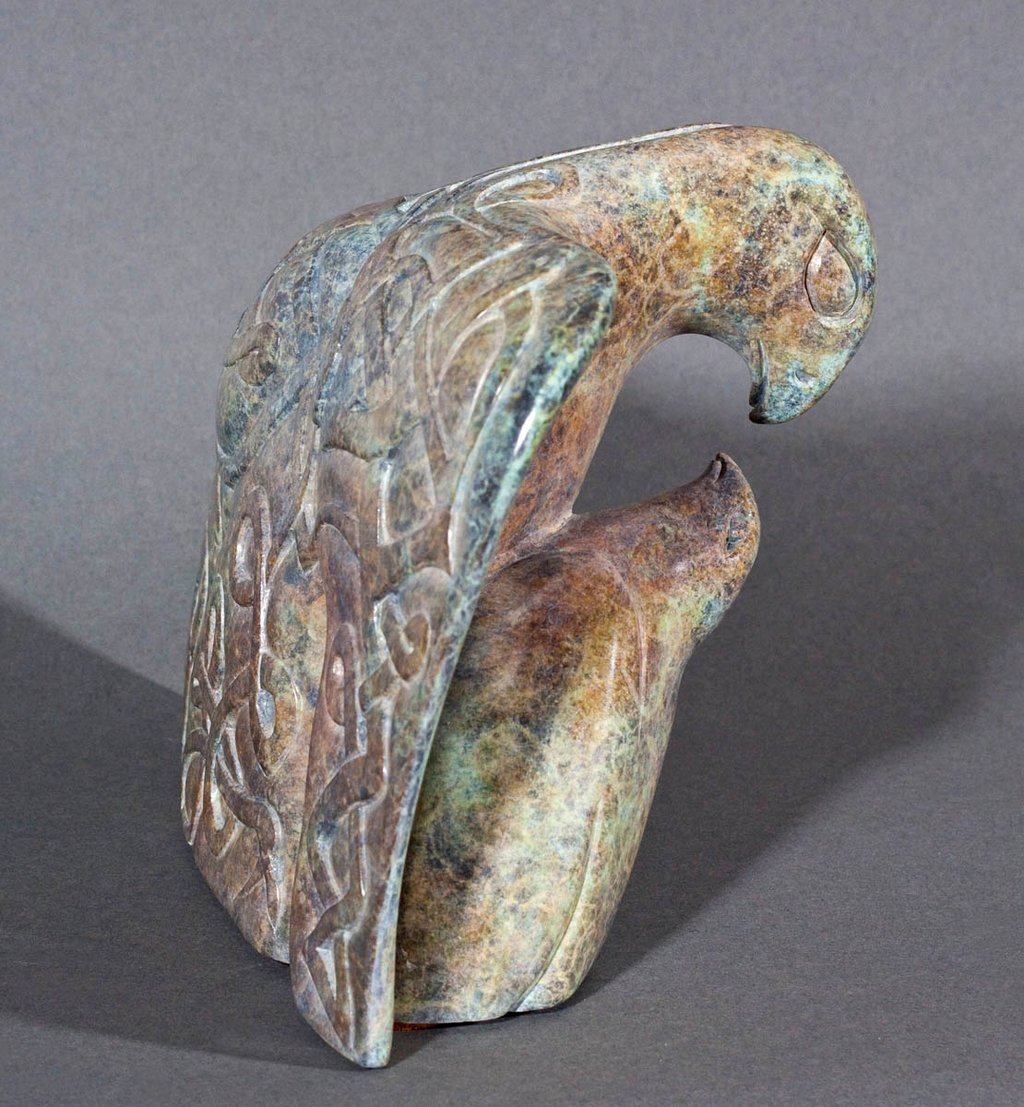
Falcon and Young
Sold
Abraham Anghik Ruben
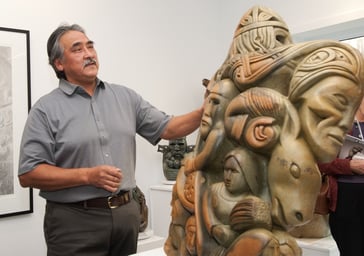
Abraham Anghik Ruben was born on November 26, 1951, at his family's winter camp south of Paulatuk in the Inuvik Region of the Northwest Territories. He is of Inuvialuit and Yup'ik descent, with his maternal great-grandparents, Apakark and Kagun, being noted Yup'ik shamans from the Bering Sea region of Alaska who migrated to the Mackenzie Delta area in the late 1890s. Until age eight, Ruben lived a traditional semi-nomadic Inuvialuit lifestyle with his family, moving among seasonal fishing and hunting camps. In 1959, he and his siblings were sent to Grollier Hall residential school in Inuvik, where he remained for eleven years until 1970. This traumatic separation from his family and culture would profoundly impact his life and later find expression in his art, including his 2001 sculpture "The Last Goodbye," which depicts his mother's anguish when his older siblings were first sent away in 1955.
In the summer of 1971, Ruben began formal art studies under Ronald Senungetuk, an Iñupiaq artist and educator who headed the Native Arts Centre at the University of Alaska Fairbanks. He returned for a full year of study from 1974 to 1975, where he developed his understanding of combining traditional materials and techniques with contemporary interpretations of myths and legends. Throughout the 1970s, Ruben pursued his artistic career, working in sculpture, jewelry, prints, and drawings. Toronto art dealer Jack Pollock introduced his work to the Toronto art scene, hosting solo exhibitions at the Pollock Gallery in 1977, 1978, 1979, and 1980. Pollock described Ruben as a contemporary sculptor with Inuit ancestry, helping establish his reputation beyond the constraints typically placed on Inuit artists.
In 1986, Ruben moved to Salt Spring Island, British Columbia, where he continues to live and work with his wife Patricia Donnelly and their children. His artistic practice deepened as he explored the stories, myths, and legends of his ancestors, creating works exhibited and collected internationally. In 1989, curator Darlene Coward Wight organized "Out of Tradition," an exhibition featuring Ruben and his brother, sculptor David Ruben Piqtoukun, at the Winnipeg Art Gallery, which then traveled across Canada's north. Ruben's work is held in major collections including the Smithsonian's National Museum of the American Indian, the National Gallery of Canada, the Canadian Museum of Civilization, the Art Gallery of Ontario, and the Winnipeg Art Gallery.
After surviving cancer in late 2004, Ruben's work took a new direction, focusing on the relationship between Inuit and Norse Viking cultures and their contact period from the early 900s to the 1400s. Inspired partly by his maternal aunt Paniabuluk, who became the Inuk wife of Arctic explorer Vilhjalmur Stefansson, Ruben researched cultures of the circumpolar world including Siberia, Scandinavia, Greenland, and Iceland. He found resonances between Inuit and Norse narratives, particularly in their shamanic traditions and reverence for the land. In 2012, the Smithsonian's National Museum of the American Indian presented "Arctic Journeys/Ancient Memories: The Sculpture of Abraham Anghik Ruben," featuring twenty-three sculptures viewed by over 500,000 visitors. His work has since been exhibited at institutions including the Louvre in Paris, the Rockwell Museum of Western Art in New York, and the Museum Cerny Inuit Collection in Bern, Switzerland.
Working primarily in stone, bone, and bronze, Ruben creates intricate multidimensional sculptures that blend human, animal, and spiritual forms, bridging Inuit and Nordic cultural traditions. In 2016, he was inducted into the Order of Canada for his contributions to the art world and for preserving Inuvialuit culture. More recently, he has expanded his practice to include painting. In 2025, the Winnipeg Art Gallery-Qaumajuq presented a major retrospective featuring over 100 works spanning his fifty-year career, marking the first solo exhibition in Qaumajuq's flagship Qilak gallery, the largest exhibition space dedicated to Inuit art in the world.
More work by Abraham Anghik Ruben